Economics and markets
AI and jobs: Still in an ATM phase
July 22, 2026
- Commentary
- Market views
- Regional outlooks
AI and jobs: Still in an ATM phase
Commentary by Adam Schickling, Vanguard Senior Economist.
On our “Market views” tab: Rotation away from large-cap tech accelerates
Every wave of technological change seems to arrive with a familiar prediction: This time, jobs are going away for good. The effect of automated teller machines (ATMs) on the bank teller profession reveals a more nuanced reality.
When ATMs became widespread in the 1980s, many people assumed bank tellers would soon become obsolete. They were only partially correct.
The number of tellers needed at individual branches did decline to some degree as ATMs automated routine tasks. Yet the broader employment outcome was less stark than feared. By lowering operating costs, ATMs made it economical for banks to open more branches. As a result, total U.S. bank teller employment remained broadly stable from 1980 through 2010. For a mid-career teller in the 1980s, the ATM posed far less of a threat to employment than many forecasts suggested.
New demand for more occupations
In fact, just as we expect artificial intelligence to transform the labor market, the expansion of retail banking created demand for a wider range of occupations. Banks hired more loan officers, credit analysts, personal bankers, and fraud and risk specialists. The work performed inside a branch moved up the skill-value chain. Branches became less about processing transactions and more about managing customer relationships.
The real disruption came later. Beginning around 2010, mobile banking changed the equation. Unlike the ATM, which automated a task, mobile banking largely automated the entire trip to a bank. Customers no longer needed to visit a branch for many everyday banking activities. By 2025, only 9% of bank customers said branches were their primary banking channel, compared with 36% in 2007.1 Bank teller employment fell accordingly.
Importantly, this transformation was not driven by technology alone. The Electronic Signatures in Global and National Commerce Act of 2000 gave electronic signatures the same legal standing as ink signatures, helping to enable fully digital banking experiences and accelerate the shift away from in-person transactions.
Technology’s impact on jobs can be transformative but isn’t always immediate
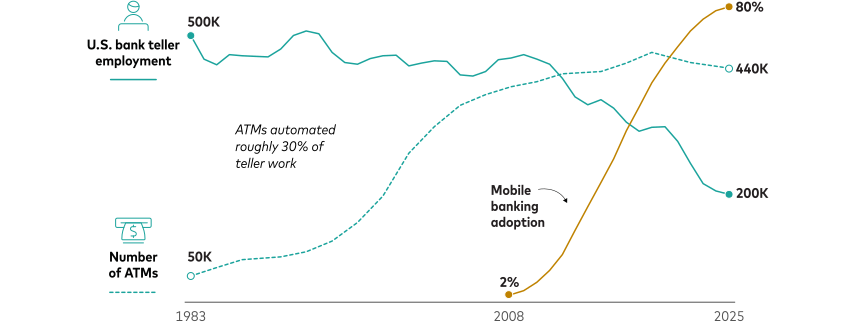
Notes: The proliferation of ATMs in the 1980s allowed for more bank branches to be opened, keeping the total number of bank tellers relatively stable rather than reducing it. Decades later, that number fell more sharply amid the rise of mobile banking, which would generate new types of jobs.
Sources: Vanguard, using data from the U.S. Bureau of Labor Statistics as of March 31, 2026.
The lesson is that isolated task automation rarely results in large-scale job losses, except in occupations built around a very narrow set of activities. (There aren’t many switchboard operators left.) More often, meaningful disruption occurs when technologies are combined with new workflows, business models, and institutional changes that fundamentally alter how work is organized.
The disruption caused by mobile banking included the creation of entirely new forms of employment: cybersecurity analysts, digital product managers, payment-platform engineers, and data-platform operators.
This history offers a useful lens for understanding today’s debate around AI. If AI becomes a general-purpose technology like electricity and the personal computer before it—as developments increasingly suggest—it will enable products, services, and industries that we have not yet envisioned. In short, fears of widespread job loss are likely overblown.
The myth of large-scale white-collar job loss
Since ChatGPT’s arrival in late 2022, many people have argued that AI will quickly eliminate large numbers of white-collar jobs. Nearly four years later, the labor market tells a different story. Occupations with the greatest exposure to AI have not experienced widespread employment declines. Employment growth in highly exposed occupations has generally kept pace with—or exceeded—that of less exposed occupations. Layoff rates remain low, and although hiring has slowed, the slowdown has been broad-based rather than concentrated in AI-intensive fields.
Today’s large language models may be reminiscent of the ATMs of the 1980s—powerful tools that automate certain tasks but augment many more, making workers more productive and leaving the broader structure of work largely intact. More significant labor market disruption may require something closer to the shift from ATMs to mobile banking: a deeper reconfiguration of business processes, organizational structures, and customer interactions that reshapes the role of workers rather than removing them from the equation.
The history of technological change suggests capabilities alone rarely determine employment outcomes. What matters more is how organizations redesign work around those capabilities.
AI may ultimately transform the labor market, just as mobile banking transformed retail banking. But the evidence today suggests we remain closer to the ATM phase than the mobile banking phase.
1 See American Bankers Association, National Survey: Bank Customers Continue to Use Mobile Apps More Than Any Other Channel to Manage Their Accounts, November 18, 2025, available at https://www.aba.com/about-us/press-room/press-releases/national-survey-preferred-banking-methods. For the earlier comparison, see Electronic Payments International, Generations Differ on Preferred Banking Channels in the US, May 1, 2007, which reports results of an American Bankers Association survey finding that 36% of consumers used branches most often, available at https://www.electronicpaymentsinternational.com/news/generations-differ-on-preferred-banking-channels-in-the-us/.
Rotation away from large-cap tech accelerates
Market views by Shaan Raithatha, Vanguard Senior Economist.
The “Magnificent Seven,” the large-cap tech companies that have been the darlings of the U.S. stock market for so long, underperformed in the first half of 2026. While the Standard & Poor’s 500 Index returned a healthy 9%, the Mag 7 fell 1%, with Microsoft and Meta being notable laggards. This underperformance intensified late in the period as the Mag 7 dropped almost 9% in June, its worst month in more than a year.
So what is going on? The dominant narrative is that investors are increasingly questioning whether the large investments committed by the AI “hyperscalers”—Alphabet, Amazon, Meta, Microsoft, and Oracle—will deliver sufficient returns amid elevated expectations and intensifying competition. This is something we flagged in the Vanguard Economic and Market Outlook for 2026.
But there is more going on behind the scenes. Rising costs for memory chips and electrical equipment are squeezing profit margins at large-cap tech companies. (Apple and Microsoft recently announced price increases for some popular products.) Two other factors also likely weighed on returns: Investors had heavy allocations to richly priced large-cap tech stocks, and the Federal Reserve pivoted to a hawkish stance, affecting growth stocks disproportionately.
Instead, investors are rotating away from large-cap tech and into companies that produce the physical components and infrastructure that are in high demand as hyperscalers ramp up their investment ambitions. These include suppliers of high-bandwidth memory (think SK Hynix and Micron) as well as providers of lithography machines (such as ASML), electrical infrastructure (such as Schneider Electric), and servers (such as Cisco and Dell).
In our midyear capital market outlook, we referred to this broader set of global companies as the “AI complex,” and highlighted material upward revisions to earnings expectations for this group in recent months. This AI complex, excluding hyperscalers, returned 100% in the first half of 2026, a significant outperformance relative to both the Mag 7 and broader S&P 500.1 We prefer this measure to the narrower (and price-weighted) Philadelphia Semiconductor Index, which is also shown in the figure for comparison.
The Magnificent Seven underperformed in the first half of 2026
Notes: The Mag 7 consists of Alphabet, Amazon, Apple, Meta, Microsoft, Nvidia, and Tesla. The “AI complex” ex hyperscalers category refers to a group of roughly 45 companies globally that are driving the physically intensive buildout of AI infrastructure, including companies focused on semiconductors, high-bandwidth memory, data centers, networking, and energy infrastructure. This group excludes the hyperscalers Alphabet, Amazon, Meta, Microsoft, and Oracle. Past performance is not a guarantee of future results. The performance of an index is not an exact representation of any particular investment, as you cannot invest directly in an index.
Sources: Vanguard calculations, based on data from Bloomberg as of June 30, 2026.
We expect the AI complex to remain volatile, given the sharp recent run-up. In the week ended July 17, the Philadelphia Semiconductor Index and Asian technology stocks came under significant pressure amid concerns that the trade may have gotten ahead of itself, and on news of the launch of a Chinese AI model, called Moonshot, that could rival top U.S. systems.
Looking ahead, we remain constructive on the shorter-term outlook for equities as the AI investment cycle deepens. A decrease in oil prices from recent highs amid conflict in the Middle East should also be supportive for risk sentiment.
Our medium-term outlook is more cautious. The next phase of the AI story is more about whether current investment translates into productivity gains for the broader global economy. History tells us that over time, the benefits of general-purpose technologies spread throughout the economy from the sector that drove the initial innovation. This tendency, coupled with already stretched valuations in U.S. growth stocks, is why we continue to prefer U.S. value stocks and developed markets equities outside of the U.S. over longer time horizons.
1 Local currency price return, weighted by market capitalization in U.S. dollars.











Notes:
All investing is subject to risk, including possible loss of the money you invest.
Diversification does not ensure a profit or protect against a loss.
Investments in bonds are subject to interest rate, credit, and inflation risk.
Investments in stocks or bonds issued by non-U.S. companies are subject to risks including country/regional risk and currency risk. These risks are especially high in emerging markets.
Past performance is no guarantee of future results.