Economics and markets
The great rotation: When valuations matter again
March 19, 2026
- Commentary
- Market views
- Regional outlooks
The great rotation: When valuations start to matter again
Commentary by Andrew Shuman, Director of Research, Vanguard Oversight & Manager Search, and Kevin Khang, Vanguard Senior Global Economist
On our “Market views” tab: Oil curve points to shock, not lasting disruption
More than a decade of U.S. equity market leadership was interrupted by a historic rally in non-U.S. equity markets last year. Now, investors are debating whether the long‑anticipated “great rotation” is finally taking shape.
Great rotation adherents point to accelerated investment in physical goods
Those on the “yes” side of the debate see market strength as broadening beyond mega-cap, tech-heavy U.S. equity to capital-intense industries globally. Across the world, infrastructure investment, energy security initiatives, and supply‑chain reshoring are moving from planning stages to execution. This means accelerated investment in physical goods and earnings growth in sectors close to this shift.
Europe provides a clear example. Increased defense spending and accelerated investment in renewable energy are supporting multiyear demand for capital‑intensive sectors such as industrial equipment, materials, and utilities. These trends favor companies with tangible assets, long‑dated cash flows, and pricing power—areas that had been underrepresented in global portfolios during the asset‑light growth era. The effects are also visible in commodities markets and in emerging economies that supply key inputs for these projects.
Additionally, the investment footprint of an AI-driven capital buildout reaches well into the broad U.S. equity market. The spending requirements associated with AI are driving demand for semiconductors, advanced manufacturing equipment, and electrical equipment. Many of the key companies benefiting from this development are listed outside the U.S.
AI is reshaping sector dynamics within the U.S. too. Utility and energy companies—historically valued for income rather than growth—are seeing improved valuations as electricity demand rises and grid investment accelerates.
Adherents of the status quo see continued merit in tech-heavy U.S. equities
Those on the “no” side of the great rotation debate see continued investing merit in tech-heavy U.S. equities. Over extended horizons, equity returns tend to be driven by a relatively small number of highly successful firms. While these firms change over time, the U.S. continues to be the primary incubator of such companies. Deep capital markets, a strong venture-capital ecosystem, and a culture of innovation all support the creation and scaling of new technologies.
The U.S. also benefits from institutional features that support rapid adoption of innovation. Flexible labor markets, comparatively strong corporate governance, and a culture of risk-taking all increase the likelihood for productivity gains that translate into earnings growth.
Geopolitical considerations reinforce this position. The U.S. operates as a large, relatively self‑sufficient economy with robust domestic energy and food supplies. In periods of heightened geopolitical uncertainty, as we’re currently experiencing, this insulation has tended to support capital flows into U.S. assets and to limit relative volatility. These characteristics help explain why investors continue to assign a premium to U.S. equities.
Valuations help inform our stance
Valuations remain central to the rotation discussion. While valuations are not a timing tool, they play a critical role in shaping outcomes as market narratives evolve. Market movements in February underscored the risks associated with stretched valuations. The sharp decline in parts of the software and IT services sector following heightened concerns about AI‑driven disruption illustrates how quickly sentiment can change due to the prospect of business model disruption. After years of strong performance and rising multiples, these stocks had little valuation cushion when narratives turned.
Attractive valuations preceded higher returns across global equity markets
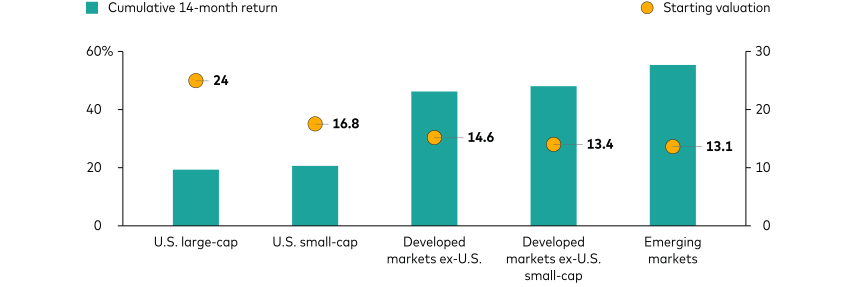
Notes: This chart shows forward price/earnings ratios as of year-end 2024 based on Institutional Brokers’ Estimate System consensus earnings-per-share expectations for the S&P 500 Index to reflect the U.S. large-cap category, Russell 2000 Index to reflect the U.S. small-cap category, MSCI EAFE Index to reflect the developed markets ex-U.S. category, MSCI EAFE Small Cap Index to reflect the developed markets ex-U.S. small-cap category, and MSCI Emerging Markets Index to reflect the emerging markets category. Returns are cumulative from year-end 2024 through February 2026. Past performance is no guarantee of future returns. The performance of an index is not an exact representation of any particular investment, as you cannot invest directly in an index.
Sources: Vanguard calculations, using data from FactSet, as of February 28, 2026.
Whereas stretched valuations leave stocks vulnerable to a sudden business model disruption, the low expectations underlying low valuations can provide resilience—and potential upside. As shown in the accompanying chart, many non-U.S. companies entered 2025 with historically attractive valuations and, when sentiment improved, the most attractively valued stocks appreciated the most.
The Standard & Poor’s 500 Index continues to trade near the upper end of its historical valuation range, reflecting both strong earnings growth and a premium assigned to U.S. corporate resilience. By many measures, it is a stretched valuation that requires continued earnings growth and, importantly, a lack of economic developments that call this trend into question.
In contrast, many non-U.S. equity markets continue to trade closer to long‑run averages. Granted, the valuation gap between U.S. and non-U.S. equities has narrowed following last year’s rally. However, after years of U.S.-driven equity market growth, continued optimism underlies current U.S. valuations, whereas guardedness surrounds non-U.S. equity valuations. Similarly, many segments of the global equity market outside of the mega-cap tech space continue to be under-owned in global portfolios.
Diversification adds resilience
Today’s environment presents a very different backdrop from what persisted for most of the past decade, when U.S. large-cap growth equities reliably and consistently outperformed, making style, market capitalization, and regional diversification seem unnecessary. Against the current backdrop, our view remains that within the equity portion of their portfolios, investors would benefit from the diversification derived by leaning into more reasonably valued market segments, both U.S. and non-U.S. Such diversification adds resilience and upside potential should fast-moving AI, which has started to disrupt many businesses and investment narratives, diffuse through the global economy.
Oil curve points to shock, not lasting disruption
The outbreak of conflict in Iran has abruptly ended the unusual oil‑market dynamic highlighted in our February “Market views” article. At that time, geopolitical risk premia supported the front end of the Brent curve even as weakening supply-demand fundamentals weighed on longer‑dated spreads. The conflict has brought those forces into sharper alignment.
Expectations for oil supply and demand converge anew
Note: Data reflect 30-day moving averages of Brent crude spreads.
Sources: Vanguard calculations, based on Bloomberg data, as of March 16, 2026.
It has also triggered one of the largest oil supply disruptions in decades, centered on the effective closure of the Strait of Hormuz. Roughly 20% of global seaborne oil trade—and a similar share of liquefied natural gas—flows through the strait, making the duration of disruption the key determinant of further energy price spikes. Near-term prices have spiked as supply has been curtailed.
Importantly, while short‑ and long‑dated Brent crude spreads—key indicators of supply-demand conditions and geopolitical risk premia—have moved into closer alignment since the start of the conflict, the response further out on the curve has been comparatively muted. The Brent 36‑month contract has risen only modestly since late February, compared with a much larger spike in the front-month contract. This divergence suggests that, despite the severity of the near‑term shock, market participants continue to expect a relatively swift resolution rather than a long-lasting loss of supply.
That said, $100‑plus Brent is no longer an extreme outcome: The front-month Brent contract traded over $100 from March 12 through March 17. As this March 10 Vanguard article notes, a protracted period of oil over $100 would weigh on growth and spur inflation in the U.S., the euro area, and Japan.
The oil shock is now feeding directly into broader macro pricing through terms‑of‑trade‑driven currency moves, higher near-term interest rates, and suddenly rising inflation expectations. As elevated oil prices persist, concerns about economic growth and tightening financial conditions are complicating monetary policy outlooks.
As events continue to unfold, oil markets will remain a critical barometer of escalation risk. For investors, the message is unchanged: Periods of geopolitical stress can drive sharp, unsettling price moves, but discipline and a long‑term perspective remain essential amid heightened volatility.
—Fei Xu, Vanguard Commodity Strategy Fund Portfolio Manager










Notes:
All investing is subject to risk, including possible loss of the money you invest. Be aware that fluctuations in the financial markets and other factors may cause declines in the value of your account. There is no guarantee that any particular asset allocation or mix of funds will meet your investment objectives or provide you with a given level of income. Diversification does not ensure a profit or protect against a loss.
Prices of mid- and small-cap stocks often fluctuate more than those of large-company stocks.
Investments in bonds are subject to interest rate, credit, and inflation risk.
Investments in stocks or bonds issued by non-U.S. companies are subject to risks including country/regional risk and currency risk. These risks are especially high in emerging markets.
Funds that concentrate on a relatively narrow market sector face the risk of higher share-price volatility.