Economics and markets
How to invest your next dollar
January 22, 2026
- Commentary
- Market views
- Regional outlooks
How to invest your next dollar
Commentary by Kevin Khang, Vanguard Senior Global Economist
On our "Market Views" tab: An emerging equity rotation and its drivers
January is a time when interest runs high in investment return outlooks and asset allocation for the coming year. We’ve repeatedly heard three questions related to the recently published Vanguard Economic and Market Outlook for 2026.
Q1: Why does Vanguard talk about a stock market downside when AI might offer significant economic upside?
This is the question we hear most often. The answer is grounded in past disappointments.
Over a long horizon, market outcomes tend to be determined by starting valuations, market expectations supporting them, and whether the expectations are met. Today’s U.S. equity market is led by a narrow group of mega‑cap technology companies and other rising stars spending hundreds of billions of dollars on AI infrastructure. (In our outlook paper, we call them “AI scalers.”) Many of these firms have extraordinary earnings power but also historically elevated valuations. Past high‑valuation, innovation-driven investment cycles offer a surprisingly consistent pattern: While real technological progress often follows historic investment cycles, long-term returns often fall short of historical averages.
How the AI investment cycle compares so far with investment cycles for past innovations
Notes: The period starting points are: Q3 2022 for AI, Q2 1995 for telecommunications, Q1 1980 for oil and gas, Q1 1946 for auto manufacturing, and Q1 1850 for railroad. Returns for the railroad cycle are total market returns, while returns for the other cycles are in excess of the risk-free rate. The dashed line depicts the average return in excess of the risk-free rate earned on the stock market between 1926 and the present.
Sources: Vanguard calculations, based on data from Yale School of Management and the Kenneth R. French data library, as of November 30, 2025.
This isn’t a contradiction. Innovation-driven investment cycles—whether related to railroads, electrification, the internet, or now AI—tend to follow a multiyear pattern beginning with a “big bang” moment that encourages mass adoption and captures investors’ imaginations. In the first half of the cycle, budding enthusiasm, capital inflows, and accelerating earnings bring strong market performance. The second half, however, tends to be more challenging. Although the reasons vary from one investment cycle to another, a common theme is that elevated expectations (and, by extension, elevated valuations) confront the reality that not all of the early leaders will go from strength to strength. Valuations eventually need to follow the fundamentals—downward.
The pattern speaks to rotation in market leadership. These cycles often see a dramatic shift from growth-driven leadership toward more value‑focused firms in the market, especially in the later phases. Even if AI continues to reshape the economy, the payoff for investors may increasingly favor less richly valued segments of the market.
Q2: So what would Vanguard say to investors who are mostly focused on the one‑year outlook?
Nuance matters! While the long-term view for U.S. equity returns appears below average, the one‑year outlook remains constructive.
Why? Because near-term U.S. equity performance will continue to hinge on earnings growth of the very companies driving the AI theme. We expect these firms to post another year of robust earnings growth—and so does the market. As long as that multiyear trend remains intact, the backdrop for the broader market remains supportive.
Of course, in any given 12‑month window, markets can move in either direction. Short-term outcomes are always sensitive to shocks or simply to shifts in sentiment. The key risk to monitor is whatever may challenge the narrative of AI scalers’ continued earnings growth. It may be futile to guess where that challenge will come from. More important is whether such a challenge appears durable and material enough to call continued earnings growth into question. If the earnings engine appears less certain, market resilience may weaken quickly.
Q3: You’ve said that the right long-term portfolio mix is now 60% bonds and 40% stocks—not the more traditional 60% stocks and 40% bonds. But that might feel hard to grasp or implement. How should investors apply such a mix in practice?
This is a practical and often personal question. Our core message: Take the perspective seriously, but not literally.
Our strategic allocation of 40% stocks and 60% bonds reflects our own assumptions about investment horizons, long-term capital market return projections, and risk tolerance. Unless an investor agrees with us on all these dimensions, adopting the full allocation all at once may feel uncomfortable—and, frankly, inappropriate. A 40/60 long-term portfolio requires patience. The possibility of lagging a more traditional 60/40 mix is material, especially when U.S. equities are performing strongly.
Instead of treating the recommendation as a binary “switch,” we suggest thinking in terms of direction and pacing. Start with the next dollar. For investors still accumulating assets, this means directing new contributions toward the preferred allocation. For those in the decumulation stage, it means withdrawing strategically from the less preferred asset class(es). Over time, this flow-based tilting can move a portfolio meaningfully closer to the recommended allocation—without the emotional or market‑timing challenges of a one‑time shift.
So that our message is clear, the two key margins are:
- Bonds over stocks, because current yields and valuations offer a more attractive starting point for bonds than for U.S. stocks over the coming decade.
- Within stocks, value—both U.S. and international—over U.S. growth because value segments have greater relative upside once valuations normalize and AI diffuses through the economy.
Ultimately, our outlook underscores the importance of discipline: leaning into what’s attractively valued, making allocation changes thoughtfully, and letting each new dollar move the portfolio in the right direction.
An emerging equity rotation and its drivers
Global equity markets diverged notably over the past year.
Equities outside the U.S. delivered strong gains, supported by U.S. dollar depreciation and a powerful, synchronized rebound in value stocks across countries and sectors.
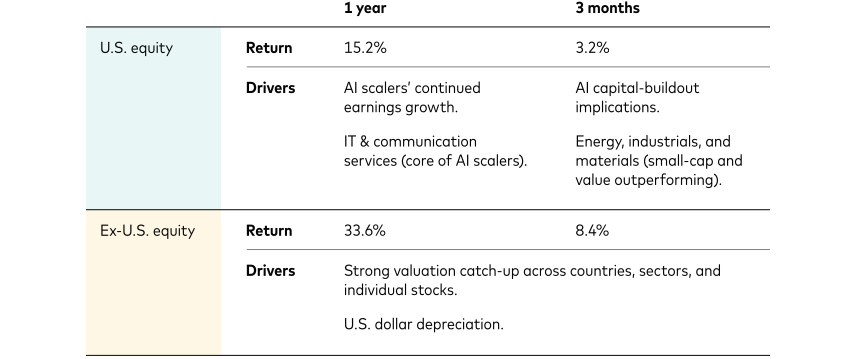
Notes: The Russell 3000 Index and the MSCI ACWI ex USA Index were used as proxies for the U.S. and non-U.S. stock markets, respectively. The returns are for the 12-month and 3-month periods ended January 17, 2026.
Sources: Vanguard calculations, using data from Bloomberg.
U.S. equities also posted solid returns, roughly 15%, though for different reasons. Market leadership remained largely concentrated in the core AI scalers—many overlapping with the so-called “Magnificent Seven” mega-cap growth stocks and the IT and communication services sectors. Their earnings growth once again exceeded market expectations and drove a substantial share of index performance. This pattern of narrow leadership persisted for the past several years.
However, more recent market dynamics suggest an AI buildout-related transition may be emerging. Over the past three months, U.S. equity performance has increasingly reflected the tangible, near‑term implications of the accelerating AI investment cycle. Demand has strengthened for the physical inputs required for AI capital buildout—including natural resources, metals, materials, industrial machinery, and energy—which has begun translating into upward earnings revisions for these segments.
The rally in precious metals such as gold and silver has added to the momentum. It is an unusual development in an environment characterized by stable economic conditions and low recession risk, and it may also be aided by elevated geopolitical uncertainty. Combined, these developments have supported a rotation in the U.S. equity market, where value and small-cap stocks have recently outperformed their large‑ and mega-cap peers.
Outside the U.S., leadership may also be poised to evolve. With deep‑value opportunities largely priced away after last year’s value resurgence, returns are starting to show more sensitivity to earnings growth than valuation catch-up. In this vein, as AI‑related capital buildout gains traction globally, international markets may reflect the same demand trends that are boosting industrials and materials in the U.S. Whether that would usher in a full rotation in equity market leadership will become clear only with time.
But this much is clear: AI capital buildout has already become an important global equity market force. And AI’s disruptive impact will likely be felt in both the economy and markets in the months to come.
—Kevin Khang, Vanguard Senior Global Economist










Notes:
All investing is subject to risk, including possible loss of the money you invest.
Diversification does not ensure a profit or protect against a loss.
Investments in bonds are subject to interest rate, credit, and inflation risk.
Investments in stocks or bonds issued by non-U.S. companies are subject to risks including country/regional risk and currency risk. These risks are especially high in emerging markets.