Research summary
Saving today for a child’s tomorrow
August 25, 2026
You know you want to save for your child's future, but you’re not sure exactly what you're saving for or which type of account to choose. That's a common challenge savers face, because the account type that works well for one goal may be a poor fit for another. Vanguard's latest research points to a simple solution: Start saving early, refine your goals over time, and align accounts as those goals come into focus.
In our research paper Saving for a Child’s Financial Future, we provide a framework based on a cycle of savings decisions for funding a child’s or grandchild’s future. The research outlines a three-step approach to saving for a child:
- Start saving early and maintain flexibility.
- Clarify your goals as much as possible.
- Shift to accounts that best align with your child’s education, retirement, or general spending goals as clarity develops.
Then, review your plan regularly as the child grows and family circumstances change.
Start flexible, stay flexible, and refine over time
“Most families don't begin with a fully formed savings strategy, and that's OK,” said Clifford Felton, a Vanguard investment strategist and lead author of the research. “What's more important is getting started. As your child's future becomes clearer, you can fine-tune where new savings go. A parent-owned taxable account can offer flexibility in the early years, giving families a place to save while keeping their options open.”
Early on, it's also worth looking at opportunities such as Trump accounts and 529 plans. If your child is eligible for Trump account funding, whether through the federal seed contribution, an employer, or another source, consider claiming it. It's an easy way to get money invested early and take advantage of benefits that may not be available later. And even if you're not sure how much you'll ultimately save for education, opening a 529 plan can still make sense. A small contribution starts the clock on future rollover flexibility, allowing up to $35,000 of unused education savings to be rolled to a Roth IRA over time if certain requirements are met.1
As your goals take shape, you can consider more specialized accounts that better match your needs.
“Families don’t need to know exactly what the funds will be used for before they begin saving for their child,” said Boris Wong, a Vanguard investment strategist and coauthor of the research. “They can start while goals are still unclear, and that flexibility is often more important than perfect planning.”
Match accounts to goals
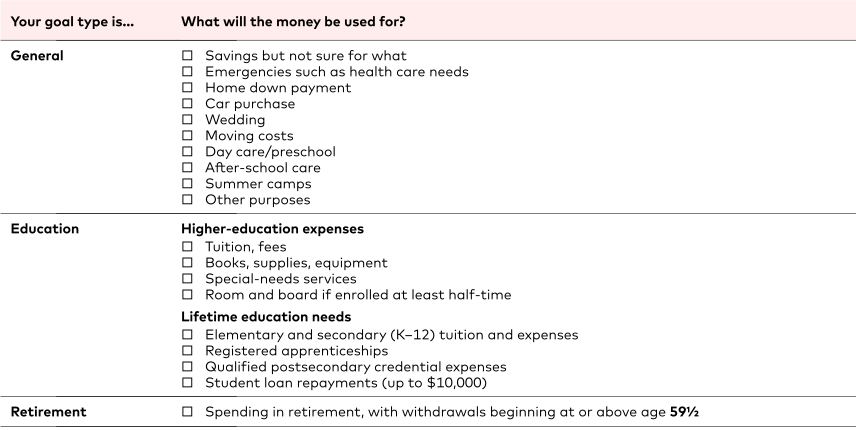
When you're ready to refine your goals, the next step in the framework is to ask yourself how the money will be used.
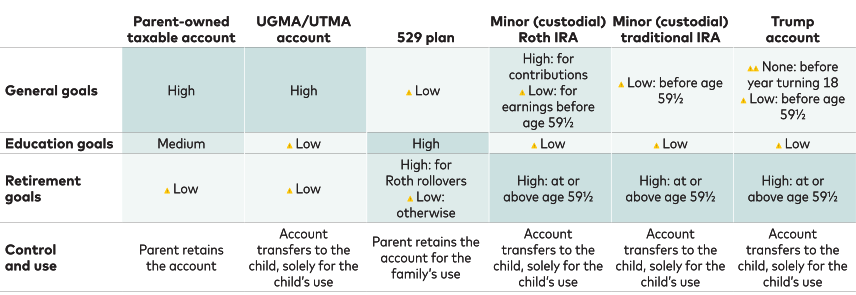
“Most child-focused goals fall into three categories: general savings, education, and retirement,” Felton said. “Each goal aligns with different account features, and you're often balancing three priorities: spending flexibility, tax efficiency, and control.”
Use flexible accounts for general savings. A parent-owned taxable account—in addition to being a place to hold assets while you refine goals for your children—can be used for things such as emergencies, health care, day care, preschool, after-school care, summer camps, or a financial cushion for the child as they enter adulthood.
Choose the right tool for education. When you know you're funding educational expenses, a 529 plan is typically the go-to account. These plans support a broad range of higher education expenses and lifetime learning opportunities with tax-sheltered growth and withdrawals that are free from federal taxes. In some states, 529 plans come with state tax benefits when you contribute and use the money for qualified education expenses.2
Build child retirement savings early. For families confident that the money can stay invested long term, minor Roth IRAs offer a powerful tool for building early retirement savings. If your child has earned income, you can explore matching their earnings to help them start. The account grows tax-free, and contributions are accessible at any time—though the real power lies in decades of compounding growth.3 For children without earned income or who have maximized their IRA contributions, there are two other tools to consider when building early child retirement savings. One is using a 529 plan to Roth IRA conversion strategy. 529 funds can be rolled over to a Roth IRA (subject to a lifetime limit of $35,000 and other requirements). The other tool is a Trump account, which may work well when you are comfortable with the money being inaccessible until the child turns 18.4
Uncover your goals
Notes: Definitions of IRA-qualified expenses can be found in IRS Publication 590-B, and those for 529 plans in IRS Publication 970. Not all states conform to federal rules for qualified withdrawals for IRAs or 529 plans. State tax treatment of withdrawals for K-12 expenses, apprenticeship program expenses, student loan repayments, Roth IRA rollovers, and postsecondary credentialing program expenses is determined by the state(s) where the taxpayer files state income tax. Please consult with a tax advisor for further guidance. For more information about any 529 plan, contact the plan provider to obtain a Program Description.
Source: Vanguard.
Review and adjust
The research stresses that a good plan is not always a fixed one but rather one that can evolve over time to meet your child’s changing needs. For this reason, parents should review their child savings plan at least yearly or if family objectives change.
“But the most important step is to start early, even if your goals are unclear,” Wong said. “Parents should adjust as clarity emerges by revisiting their plan once a year, or sooner as their child grows and family circumstances change.”
How accounts may align to your goals
Notes: Caution signs in the table indicate considerations around goal compatibility, such as reduced spending flexibility compared with other account types reviewed. The right account depends on your personal situation, goals, and financial circumstances. You may wish to consult a qualified advisor before making decisions or taking action.
Source: Vanguard.
1 Federal tax and penalty-free rollovers from 529 accounts to Roth IRAs are allowed under certain conditions. For a description, see IRS Publication 970. States’ treatment may vary. For more information about any 529 savings plan, contact the plan provider to obtain a Program Description. Certain restrictions apply. Rollover must be to a Roth IRA maintained for the benefit of the beneficiary. Rollovers can only be made from accounts open for at least 15 years and cannot include contributions or earnings on those contributions made within the last 5 years. The annual rollover limit is subject to IRA annual contribution limits with a lifetime rollover limit of $35,000. Additional restrictions may apply under federal IRA rules and guidance. Consult your tax advisor prior to initiating a rollover.
2 Subject to state tax rules and limitations that may change over time. Earnings on nonqualified withdrawals may be subject to federal income tax and a 10% federal penalty tax, as well as state and local income taxes. The availability of tax or other benefits may be contingent on meeting other requirements.
3 Withdrawals from a Roth IRA are generally tax-free if you are over age 59½ and have held the account for at least five years; withdrawals of earnings taken prior to age 59½ or five years may be subject to ordinary income tax or a 10% federal penalty tax, or both. (A separate five-year period applies for each conversion and begins on the first day of the year in which the conversion contribution is made.)
4 Certain cash contributions to Trump accounts may qualify for an IRS safe harbor and generally will not require gift-tax reporting. Additional gifts, contributions that fall outside the safe harbor, or other circumstances may still require the filing of IRS Form 709. For more information, see IRS Revenue Procedure 2026-25 and consult a tax advisor regarding your specific situation. Withdrawals are not generally allowed until the year the child turns 18. For definitions of Trump account qualified withdrawals and penalty exceptions, see IRS Publication 590-B. Some states may tax Trump accounts despite favorable federal treatment. We recommend speaking with a tax advisor for up-to-date information for your state.


Notes:
For more information about any 529 college savings plan, contact the plan provider to obtain a Program Description, which includes investment objectives, risks, charges, expenses, and other information; read and consider it carefully before investing. If you are not a taxpayer of the state offering the plan, consider before investing whether your or the designated beneficiary’s home state offers any state tax or other benefits that are only available for investments in such state’s qualified tuition program. Vanguard Marketing Corporation serves as distributor for some 529 plans.
All investing is subject to risk, including the possible loss of the money you invest. Be aware that fluctuations in the financial markets and other factors may cause declines in the value of your account. There is no guarantee that any particular asset allocation or mix of funds will meet your investment objectives or provide you with a given level of income.
Diversification does not ensure a profit or protect against a loss.
Withdrawals from a Roth IRA are generally tax-free if you are over age 59½ and have held the account for at least five years; withdrawals of earnings taken prior to age 59½ or five years may be subject to ordinary income tax or a 10% federal penalty tax, or both. (A separate five-year period applies for each conversion and begins on the first day of the year in which the conversion contribution is made.)
There are important factors to consider when rolling over assets to an IRA. These factors include, but are not limited to, investment options in each type of account, fees and expenses, available services, potential withdrawal penalties, protection from creditors and legal judgments, required minimum distributions, and tax consequences of rolling over employer stock to an IRA.
Neither Vanguard nor its financial advisors provide tax and/or legal advice. This information is general and educational in nature and should not be considered tax and/or legal advice. Any tax-related information discussed herein is based on tax laws, regulations, judicial opinions, and other guidance that are complex and subject to change. Additional tax rules not discussed herein may also be applicable to your situation. Vanguard makes no warranties with regard to such information or the results obtained by its use, and disclaims any liability arising out of your use of, or any tax positions taken in reliance on, such information. We recommend you consult a tax and/or legal advisor about your individual situation.
CFA® is a registered trademark owned by CFA Institute.
Certified Financial Planner Board of Standards Inc. owns the certification mark CFP®, CERTIFIED FINANCIAL PLANNER, in the U.S., which it awards to individuals who successfully complete CFP Board's initial and ongoing certification requirements.
Contributors

Clifford Felton