Research summary
Beyond emergency funds: A smarter cash strategy
June 09, 2026
Cash is often framed as emergency savings. In reality, it does far more. It’s the money that keeps a financial plan working day to day, covering expenses expected within the next year so the rest of a portfolio can stay focused on long-term goals.
What cash is really for: Covering the next year
Cash is often defined narrowly as emergency savings. But that framing misses its primary role in a financial plan.
In practice, cash covers expenses expected within the coming 12 months. It supports everyday spending, provides a buffer for unexpected costs, and supplies funding for planned near-term needs without exposing those dollars to market risk.
New Vanguard research, A Practical Guide to Managing Your Cash, reframes cash as a tool for short-term liquidity, absorbing swings in income and expenses so that long-term investments can stay focused on growth.
In other words, cash isn’t just a reserve. It’s what allows the rest of your plan to stay invested and on track.
“We want people to think about cash as the money they need for expenses in the near term—not just emergencies, but everything happening in the next year,” said Stephen Weber, CFP®, CLTC®, a Vanguard senior researcher of advised wealth management strategies and a co-author of the research paper.
A simple cash framework: Today, someday, and later
When cash is viewed in terms of timing, the next step is organizing it by time horizon: identifying it as “today” expenses, “someday” expenses, or “later” expenses.
Today expenses cover money you expect to pay within the coming 12 months, a time frame in which cash plays a central role. Someday expenses are for less imminent and less predictable needs, while later expenses support long-term goals, for which investments—not cash—are better suited for growth. Within the today expenses bucket, cash serves three distinct roles: everyday spending, unexpected emergencies, and short-term goals. Organizing cash this way can clarify how much to hold, where to keep it, and how to use it. Instead of treating cash as a single bucket, you can allocate your money for specific needs and time frames.
Use cash for the expenses you expect in the next year
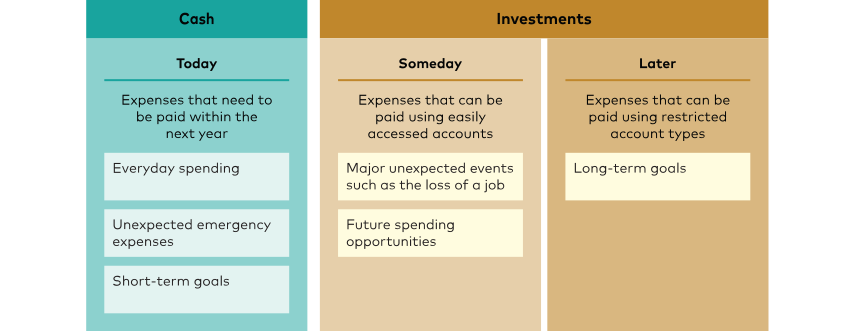
Source: Vanguard.
Spending cash: Managing day-to-day finances
Spending cash covers recurring expenses as part of the ongoing flow of income and bills, typically through checking or cash management accounts. The challenge isn’t just what’s spent; it’s when money comes in and goes out. Income and expenses rarely move in a straight line. Paychecks may vary, bills can cluster, and spending fluctuates. A cash buffer can help absorb these swings by bridging timing gaps and smoothing income variability. For many investors, that means holding around three months of expenses in spending cash, while retirees, who often rely on more portfolio withdrawals, may choose to hold up to 12 months’ worth or more.
“Income and expenses don’t move in a straight line month to month, so having a cash buffer helps people manage that variability,” said Vanguard senior behavioral economist Paulo Costa, Ph.D., CFP®, a co-author of the research paper. “Having that cushion in place can also reduce the need to rely on credit cards or other high-interest borrowing, while helping households avoid missed payments or late fees.”
Emergency cash: Preparing for the unexpected
Emergency cash is set aside for unexpected events such as medical expenses, repairs, or job loss. Its purpose is stability: funds that can be accessed quickly and used without disruption. It supports spending when normal cash flow breaks down or just isn’t enough. Keeping those reserves separate from spending cash can help preserve their intended use.
For larger or longer-lasting shocks, cash alone may not be enough. Vanguard’s research distinguishes between emergency savings for typical expenses and a broader contingency reserve—often held in easily accessible investment accounts—for more significant disruptions. A common starting point is about three months of expenses in cash, with an additional three to six months of reserves available for larger shocks.
Cash for short‑term goals: Safeguarding money you need soon
Cash can also play a key role in funding planned expenses expected within the next 12 months, such as tuition, travel, taxes, or home projects. Here, the priority isn’t flexibility; it’s safeguarding money earmarked for near-term use. Because these funds are typically held in low-risk, liquid vehicles, short-term cash reserves can be used with confidence when needed, without introducing unnecessary risk.
How much cash is too much?
Cash can provide flexibility and peace of mind, helping to manage short-term needs and uncertainty. But over time, it may not keep pace with inflation or long-term investments. Holding too much cash can reduce a portfolio’s growth potential, particularly when funds extend beyond near-term needs.
The goal is balance: Keep enough cash to cover short-term needs, but not so much that it limits long-term progress.
Reviewing a cash strategy: Three questions
A well-structured cash strategy comes down to three questions: Why is cash being held? How much is needed? And where should it be kept?
Each cash allocation should serve a clear purpose. The amount should reflect your income stability, spending patterns, and comfort level. Where you hold each allocation should balance accessibility with a competitive return. Also, small adjustments such as moving excess cash into a higher-yield option can improve outcomes without adding risk.
Taken together, these choices can ensure that cash supports near-term needs, so that the rest of your portfolio can remain invested for long-term growth.



Notes:
All investing is subject to risk, including the possible loss of the money you invest.
Certified Financial Planner Board of Standards Inc. owns the certification mark CFP® in the U.S., which it awards to individuals who successfully complete CFP Board's initial and ongoing certification requirements.
Contributors

Paulo Costa Ph.D., CFP®