Research summary
New 401(k) match formulas can unlock retirement gains
August 04, 2026
Every year, U.S. employers contribute around $250 billion to their employees' retirement accounts. But are commonly used match formulas designed well?
New research conducted by Vanguard’s Fiona Greig, in collaboration with Guillermo Carranza, Taha Choukhmane, Cormac O’Dea, and Lawrence Schmidt, Better Match Formulas for 401(k) Plans, draws on companion academic work to identify how employer match formulas can be changed in order to improve retirement outcomes for millions of American workers.1
The challenge with current match formulas
Employer match dollars are not reaching their full potential. “Almost 60% of matching contributions accrue to the 43% of employees who contribute above the match cap, meaning they've already demonstrated a willingness to save beyond what the match rewards,” said Greig, Vanguard’s global head of Investor Research and Policy. “Meanwhile, many lower-income workers receive no employer contribution at all if they choose not to participate in the plan.”
These patterns suggest that common match formulas aren’t maximizing participation or retirement readiness.
Significant gains are within reach
Moving to better match formulas could generate substantial benefits without increasing costs for employers. The research compared common match formulas with cost-neutral alternatives and identified formulas that can increase worker saving rates while decreasing inequality for the same cost, shown as the darker blue dots in the chart below.
Specifically, better match formulas pair nonelective contributions that aren’t contingent on worker contributions with a “stretched match,” which offers a lower match rate (e.g. 25%, rather than 100% match) up to a higher match cap (e.g. match up to 10%, rather than 6% of pay). The combination of these two elements ensures full participation in the plan and can generate higher worker saving rates without increasing employer costs.
Two key behavioral patterns underpin this finding: first, nonelective contributions do not crowd out worker savings and second, low match rates are more cost-effective because saving behavior only modestly responds to match rates. The implication is that employers could reallocate match dollars to a non-elective contribution and stretch their match up to a higher cap without causing workers to save less or costing the employer more.
Employers considering a change to their match formula need to determine which approach best meets their plan objectives. For example, if the objective was to increase the total savings of workers who were not yet participating in the plan, allocating more dollars to nonelective contributions would increase that group’s total savings but would have little effect on overall worker savings.
Many cost-equivalent match formulas would increase savings, decrease inequality, or both
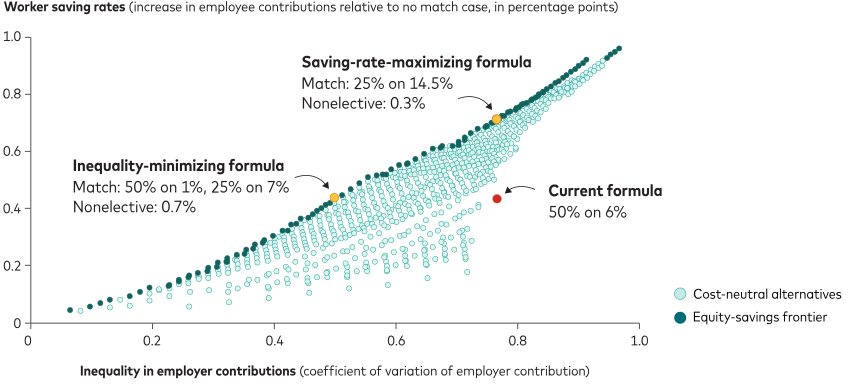
Notes: This figure compares employer match formulas that all have the same total cost as that in a typical plan design (a 50% match of up to 6% of pay), shown in red and labeled as “current formula.” Each of the other circles represents an alternative cost-equivalent formula. The horizontal axis shows how unequal employer contributions are across workers, measured by the coefficient of variation, while the vertical axis shows the increase in worker saving rates. The upward-sloping pattern highlights the trade-off between boosting saving rates and reducing inequality. The darker blue dots form the frontier, tracing the set of best-performing formulas along this trade-off. Two examples are highlighted with labels along the frontier line in yellow: one that increases saving rates the most without increasing inequality and one that reduces inequality the most without lowering average saving rates.
“Our analysis shows that shifting every plan to a savings-maximizing formula could increase average employee saving rates by around 0.4 percentage points of pay, potentially adding $6.7 billion in annual retirement savings across the workforce,” said Taha Choukhmane, associate professor of finance at the MIT Sloan School of Management. “And these gains would be broad-based: The nonelective component alone would increase the share of workers receiving contributions by 36 percentage points in voluntary enrollment plans.”
A new safe harbor prototype for the future
To nudge adoption, the paper’s authors proposed a new safe harbor match formula: a nonelective contribution of at least 2% plus a 25% match of employee contributions up to 8% of pay, with automatic enrollment and immediate vesting. The combination of a meaningful nonelective contribution and a stretched match creates strong incentives for workers to save more while making sure employer dollars are shared more broadly across the workforce.
“The proposed design compares favorably with existing safe harbor options, offering both an incentive for workers to save more and features that encourage participation,” said Cormac O’Dea, assistant professor of economics at Yale University. “Participants taking full advantage would save 8% of pay and receive at least 4% in employer contributions, totaling 12%—a number closely aligned with several other retirement systems and industry guidance.”
A proposed safe harbor match with a nonelective contribution and stretched match
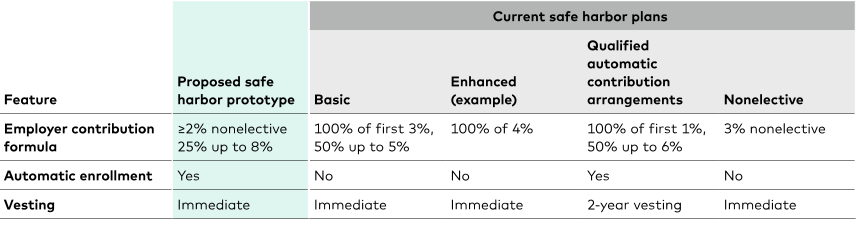
Notes: An enhanced safe harbor is one that provides at least as large a match as the basic safe harbor at every deferral point. Other conditions also apply.
An opportunity for plan sponsors and their participants
The potential for improving retirement readiness through smarter match formulas is both significant and achievable, offering plan sponsors a clear path to redeploy existing dollars more effectively while helping more Americans build financial security for their later years. Sponsors may want to consider redeploying match dollars to reach more workers and boost worker savings.
1 Guillermo Carranza, Taha Choukhmane, Cormac O’Dea, Fiona Greig, and Lawrence D.W. Schmidt. Improving 401(k) Matches Using Hypothetical Choices. SSRN, 2026.


Notes:
All investing is subject to risk.