Expert insight
What to do with your 401(k) when you leave your job
March 24, 2026
Career moves tend to focus attention on what’s changing: new responsibilities, new colleagues, and new pay. What often gets less attention is how those transitions affect a 401(k) plan.
Retirement saving works best when the money compounds steadily over time. Moments of transition can quietly interrupt that continuity as progress stalls or decisions are delayed. Understanding how these inflection points affect long-term outcomes can help investors maintain their progress.
Changing jobs often comes with a raise, a new title, or a fresh start. But data reveal that these transitions are also common points at which retirement saving momentum slows.
Vanguard research shows that the median job switcher sees a 10% increase in pay but a 0.7-percentage-point decline in their retirement saving rate when changing employers. In other words, many people earn more but save less at a pivotal moment when they could be building momentum.
This disconnect isn’t due to bad intentions. Rather, it reflects how retirement systems reset during job changes, often without workers realizing what’s been set back.
Why job changes can disrupt retirement savings
When people change employers, several elements of their retirement structure reset at once. Contribution rates may revert to a new plan’s default. Automatic escalation features may start over. And in some cases, balances from a prior plan are cashed out or rolled into an account that isn’t invested.
Even small changes can compound over time. Boris Wong, senior manager of advised wealth management strategies at Vanguard, explained that many workers steadily increase their saving rate while they stay in one role but lose that progress when they move on. “When you take a new job, retirement saving automatically cuts back to the new company’s default rate,” he said. “Even if you get a 10% raise, for example, your new saving rate could be lower than it was at the previous company.”
The result is what researchers sometimes call the “default contribution trap,” which means earning more but saving a smaller share of income. The effect can be hard to notice year to year, but it becomes clearer over a full career.
How job changes can disrupt retirement savings
Hypothetical total contribution rates by age under different job-change scenarios
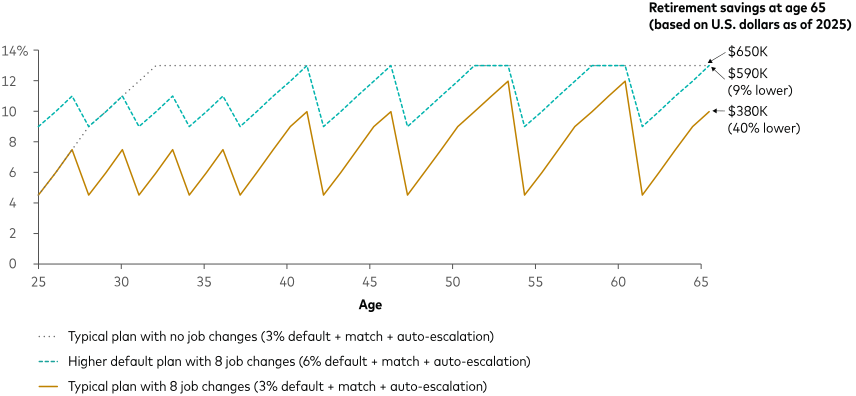
Notes: This figure shows the trajectory of total contribution rates for a hypothetical worker who begins employment at age 25 and retires at age 65. For scenarios involving job changes, the worker is assumed to change jobs every 3 years from ages 25 to 34, every 5 years from ages 35 to 44, every 7 years from ages 45 to 54, and every 10 years from ages 55 to 64. The “typical plan with no job changes” scenario assumes a starting employee contribution rate of 3%, increasing by 1 percentage point annually until reaching 10%, with this percentage then maintained until retirement. In the “typical plan with 8 job changes” scenario, the contribution rate resets to the current median default of 3% at each job transition, followed by annual 1‑percentage‑point increases until the next job change, capped at 10%. The “higher default plan with 8 job changes” scenario assumes the contribution rate resets to a higher default of 6% at each job change, with the same auto‑escalation and cap. In all three scenarios, the worker receives a 50% employer match on the first 6% of employee contributions. The worker is assumed to have a starting salary of $60,000, with nominal wage growth of 2% annually. The retirement savings are projected to grow at a constant nominal rate of 5.5% for a 60/40 stock‑bond portfolio. To isolate the effects of plan design, the same wage and return assumptions are applied across all scenarios.
Source: Vanguard, as of December 31, 2025.
How cashing out or pausing can hurt retirement savings
Contribution rate resets aren’t the only way job changes can interrupt retirement progress. Another common pitfall occurs when people leave a job and don’t actively manage what happens to their old 401(k). Some cash out small balances. Others roll money into an IRA but leave it sitting in cash.
That pause matters. “Your ability to contribute stops the moment you leave the employer,” said Andy Reed, Vanguard head of behavioral economics research. “And because of job switches, this rollover phenomenon—where balances are rolled into cash—means time out of the market.”
Being temporarily out of the market doesn’t feel dramatic in the moment, but gaps like this can materially affect long-term outcomes.
Key retirement decisions that matter during job changes
The most effective actions during a job change require attention at the right moment but are often simple:
- Avoid cashing out retirement savings, if possible. Even small balances benefit from staying invested over time.
- Make an active decision about where prior savings go. A rollover—whether into a new employer plan or an IRA—should include selecting investments, not just moving money.
- Revisit contribution settings at the new employer. Defaults are designed to help people get started, not to reflect what’s appropriate after receiving a raise or after accumulating several years of experience.
Using automation to maintain retirement savings momentum
Automation can help sustain retirement saving through job changes—but only if it’s revisited at the right moments. Many people rely on automated features and then forget to realign them after a transition.
Automatic enrollment and automatic escalation—features that get contributions started and raise them gradually over time—are powerful tools when they reflect current income and goals. After a job change, it’s worth checking that contribution rates, escalation settings, and investment choices still make sense.
The work done early can pay dividends later. “Do the work at the beginning so you don’t have to think about it constantly later,” said Wong.
Over time, consistency matters. Small increases paired with automation often have a greater impact than sporadic big moves.
Job changes can shape long-term retirement outcomes
Job changes are becoming more common, especially earlier in careers. Each move brings opportunity—but also risk if retirement savings are left on autopilot.
The key takeaway is straightforward: Earning more doesn’t automatically mean saving more. Without attention, the opposite can happen.
By staying invested, avoiding unnecessary resets, and checking settings after a transition, workers can help ensure that their career progress is matched by their progress toward retirement security.


Notes:
All investing is subject to risk.
Contributors