Research paper
Retirement income security on your terms
May 11, 2026
Target-date funds (TDFs) have helped millions of retirement savers navigate the accumulation phase with confidence. But as more participants approach retirement, a bigger challenge comes into focus: how to turn a 401(k) balance into a reliable income stream that can last a lifetime, without forcing retirees to become their own actuaries.
Vanguard research suggests that one practical answer may lie in pairing traditional target-date funds with a modest allocation to deferred-income annuities (DIA). According to Making Guaranteed Income Target-Date Funds Work in the Real World: Annuitization Benefits and Product Design, a recently published paper by Vanguard’s Ankul Daga, Vibhor Dave, and Matthew Tufano, a target-date fund with a carefully designed deferred-income annuity sleeve inside can meaningfully improve late-in-life income security—while preserving flexibility for participants who choose not to annuitize.
Target-date funds and annuities: A natural pairing for income security
The paper finds that combining a conventional TDF with a modest sleeve earmarked for guaranteed lifetime income can help create a late-in-life income floor in the scenarios participants fear most—outliving their savings, often amid weak or volatile markets. This approach is designed to address a core gap in retirement planning.
For participants focused on retirement income security, the pairing offers a familiar, low-cost TDF supplemented by a durable source of lifetime income, without requiring a full commitment to annuitization.
“TDFs manage accumulation and investment risk systematically over a participant’s working life, and annuities manage longevity risk—the uncertainty of not knowing how long retirement income needs to last,” Dave said. “Together, they address participant needs throughout their lives, not just the accumulation phase.”
Deferred-income annuities: The practical sweet spot
Our analysis compared guaranteed income TDFs allocating to three types of lifetime-income annuities: immediate annuities, DIAs, and longevity-only income that begins later in retirement. Of these, deferred-income designs emerged as the most consistently effective at improving late-in-life income security across diverse participant cohorts.
The research examined:
- Single premium immediate annuities (SPIAs), which begin paying income at retirement and are funded using 25% of the account balance at retirement.
- DIAs, which are funded ahead of retirement, with income beginning at retirement and an allocation capped at 25%.
- Qualified longevity annuity contract (QLAC)-style income, which begins later in retirement (that is, age 80 and beyond) and is funded using a smaller allocation, typically 10% of the balance at retirement.
When we assessed outcomes across participant cohorts defined by gender, income, education, and health, deferred-income designs delivered the strongest, most robust improvements in late-in-life consumption security.
“In our analysis, a modest deferred-income sleeve—capped at approximately 25% of the portfolio—can meaningfully improve late-life consumption security for participants who live longer while preserving some growth potential or liquidity,” Daga said. “Other annuity options may be effective for some, but their value can be more sensitive to spending rules and timing.”
Trade-offs in hybrid annuity TDFs
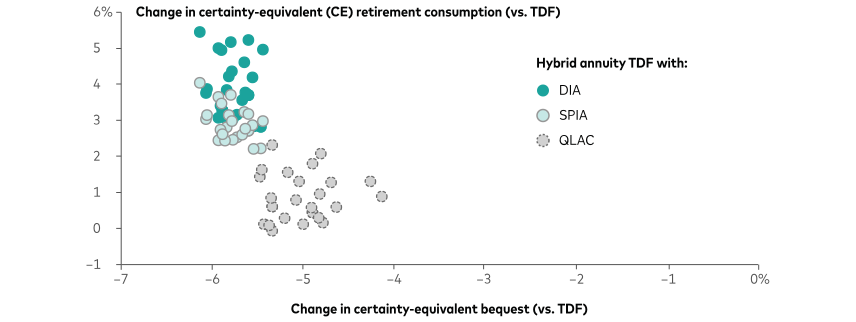
“Change in certainty equivalent” is a term used to express the differences in bequest and income between TDFs with various guaranteed income options and TDFs that don’t include these options.
Source: Making Guaranteed Income Target-Date Funds Work in the Real World: Annuitization Benefits and Product Design (Vanguard, 2026).
An option, not a necessity
Most importantly, DIA TDFs are designed to preserve participant choice. Research consistently shows that most participants do not annuitize, and plan sponsors should assume that many will continue to do so even if the plan selects a TDF with a guaranteed income option.1
“The research is clear that heterogeneity matters,” Dave said. “Participants with shorter expected horizons, smaller balances, or high Social Security coverage may be indifferent to a deferred-income sleeve, or in some cases better off without it. A well-designed guaranteed income TDF should build in protections for these types of participants.”
These guidelines are central to the paper’s conclusions and to the practical design of DIA-based guaranteed income TDFs. They include:
- Limiting annuity allocations (about 25%), which are designed to help preserve market participation and long-term growth opportunities across participant groups.
- Balance thresholds or communications that help ensure that liquidity-constrained participants retain a meaningful buffer before any assets are directed toward guaranteed income; plan sponsors might want to communicate that those with small balances might opt out or allocate less.
- A clear path to opt-out of guaranteed income and plain-language disclosure of the trade-offs associated with annuitization—more income security with less liquid wealth.
Together, these guardrails support population-level benefits of DIA TDFs while limiting predictable downside cases. Vanguard’s research offers practical ways to enhance retirement security by providing a steady income floor in old age. “A modest, deferred-income sleeve can improve outcomes for most retirees while minimizing the risk for those who choose not to annuitize,” Daga said.
1 Sources: Retirement Income in Defined Contribution Plans: Adoption, Design Preferences, and the Role of Optionality (Epperson and Bailey, 2025); Defined Contribution Institutional Investment Association Retirement Research Center; and Survey of Consumer Finances, 2019 (Federal Reserve, 2020).


Notes:
For more information about Vanguard funds, visit vanguard.com to obtain a prospectus or, if available, a summary prospectus. Investment objectives, risks, charges, expenses, and other important information are contained in the prospectus; read and consider it carefully before investing.
All investing is subject to risk, including the possible loss of the money you invest.
Investments in Target Retirement Funds and Trusts are subject to the risks of their underlying funds. The year in the fund or trust name refers to the approximate year (the target date) when an investor in the fund or trust would retire and leave the workforce. The fund/trust will gradually shift its emphasis from more aggressive investments to more conservative ones based on its target date. The Income Trust/Fund and Income and Growth Trust have fixed investment allocations and are designed for investors who are already retired. An investment in a Target Retirement Fund or Trust is not guaranteed at any time, including on or after the target date.
The Vanguard collective trusts are not mutual funds. They are collective trusts available only to tax-qualified plans and their eligible participants. The collective trust mandates are managed by Vanguard Fiduciary Trust Company, a wholly owned subsidiary of The Vanguard Group, Inc. Investment objectives, risks, charges, expenses, and other important information should be considered carefully before investing.
Diversification does not ensure a profit or protect against a loss.
There is no guarantee that any particular asset allocation or mix of funds will meet your investment objectives or provide you with a given level of income. All annuities are subject to risk, including the possible loss of the money you invest. Investments in bond portfolios are subject to interest rate, credit, and inflation risk.
Guarantees are subject to the claims-paying ability of the issuing insurance company.
The underwriting risks, financial obligations, and support functions associated with the products are the responsibility of the issuing insurance company. The issuing insurance company is responsible for its own financial condition and contractual obligations.
Deferred annuities are long-term vehicles designed for retirement purposes and contain underlying investment portfolios that are subject to market fluctuation, investment risk, and possible loss of principal. If you take withdrawals from a variable annuity prior to age 59½, you may have to pay ordinary income tax plus a 10% federal penalty tax.
Immediate variable annuities contain underlying investment portfolios that are subject to investment risk, including possible loss of principal.
Contributors