Research summary
How to turn retirement savings into reliable income
June 02, 2026
Retirement planning ultimately comes down to one question: How can you turn your savings into income that supports the life you want? The challenge isn’t just saving enough—it’s whether those savings can provide reliable income tailored to your needs and priorities while accounting for the risks of unpredictable markets and life events.
Why turning retirement savings into income can be difficult
Retirement planning is inherently personal, such that no two retirements look exactly alike. Two investors with similar account balances may have very different financial outcomes in retirement, depending on their spending needs, income sources, and personal goals.
Uncertainty—due to risk factors including market volatility, inflation, health care costs, and life span—can make it difficult to know how much to spend and when. When income is uncertain, these risks matter more, which may lead people to either underspend out of caution or overspend without realizing the long-term impact it could have.
New Vanguard research, Vanguard’s Principles for Retirement Income, reframes the conversation by focusing less on how investors accumulate assets, and more on how they can generate reliable, sustainable income that aligns with their needs, priorities, and risks.
A decision framework for retirement income
Rather than prescribing a single strategy, the guide provides a decision-oriented framework that focuses on the choices that inform retirement income strategies. Specifically, the framework is designed to help investors:
- Clarify the decisions that shape retirement income and spending.
- Evaluate the trade-offs among spending and risks, including longevity.
- Establish a plan that aligns with their retirement goals and priorities.
The research is grounded in a simple idea: Retirement outcomes depend not only on how much investors have saved, but also on how effectively those assets are converted into income that supports their desired lifestyle in retirement.
“This isn’t about prescribing one ‘right’ way to generate income,” said Joel Dickson, Vanguard global head of advised strategies. “It’s about helping people understand the decisions that matter most and giving them a clearer way to think through the trade-offs behind those decisions.”
Four principles for turning savings into income
The framework is built around four principles that move from defining priorities to sustaining income and simplifying decision-making over time.
Start with purpose
The first step is defining your goals, priorities, and desired lifestyle, because in retirement, what matters most to you becomes the measure of success. This approach considers your needs, wants, and wishes more than a single savings target.
Cover the essentials
A strong retirement plan starts by securing core expenses. Essential costs like housing, food, and health care should be supported by reliable income sources like Social Security, pensions, and annuities—and, for some, continued work in retirement—ensuring that those costs are covered.
One practical way to do this is to identify essential expenses through a simple budget or as a share of total spending, and then to ensure those costs are covered by stable, predictable income sources. This foundation can help preserve your standard of living and reduce uncertainty over time.
Make your wealth last
After your essential expenses are covered, the focus shifts to sustaining income over time. Things like portfolio withdrawal rates, tax planning, and investment strategy can all influence how long your portfolio can support your spending.
Even small adjustments, such as lowering your withdrawal rate and taking steps to improve tax efficiency, can materially extend how long your income lasts throughout retirement while still allowing you to maintain the flexibility to adapt as conditions change.
Simplify
Managing retirement income can become complex, particularly if you’re dealing with unexpected expenses, health concerns, or volatile markets. Simplifying your financial life by consolidating accounts, automating withdrawals, and streamlining income strategies can make it easier to stay on track and reduce the risk of inconsistent or reactive decisions.
Why income matters more than balances
Focusing on income rather than account balances can lead to clearer decision-making in retirement.
Without a defined income plan, investors may spend too cautiously or risk drawing down their assets too quickly. With an income-focused framework, you can better understand how to turn your savings into spending by having a clearer view of:
- How much you can withdraw over time.
- How long your assets may need to last.
- How different risks can affect outcomes.
How withdrawal rates affect retirement sustainability
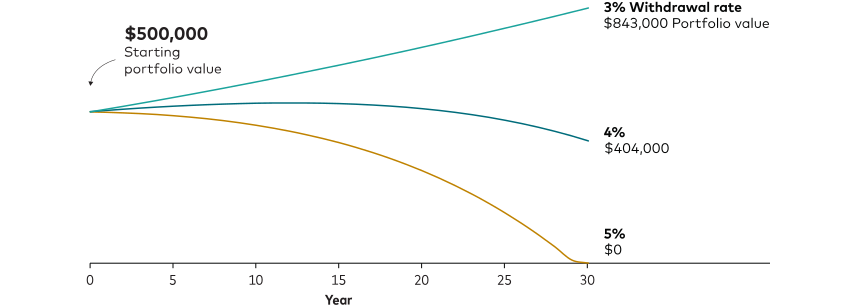
Notes: These calculations assume a portfolio with an initial balance of $500,000 and annual returns of 5%. In each case, the initial withdrawal amount is increased by 2% annually at the beginning of each year to account for inflation. Values are rounded to the nearest thousand. This hypothetical illustration does not represent the return on any particular investment, and the rate of return is not guaranteed.
Source: Vanguard.
Designed for flexibility and real life
The framework is designed to be flexible through your retirement journey. It can be applied by those who are approaching retirement, those who have retired recently, or retirees who want to adjust their plan.
Rather than prescribing a fixed path, the principles are intended to be used together or individually, depending on how they apply to you. This flexibility allows you to pick and choose the strategies that apply best as your income needs and life circumstances change.
Putting the principles into practice
“The last day of work is a milestone, but retirement is a long journey shaped by decisions that evolve over time,” said Garrett Harbron, Vanguard head of advised wealth management strategies. “These principles offer a strong foundation—and when markets, taxes, or individual or family circumstances add complexity, a financial advisor can help you personalize this approach and guide decision‑making as your needs change.”
Read more in Vanguard’s Principles for Retirement Income.

Notes:
All investing is subject to risk.
Contributors