Investor behavior
Discipline prevails during geopolitical shocks
May 12, 2026
While headlines paint a picture of panic during geopolitical shocks, the reality of investor behavior tells a different, calmer story. When tensions in the Middle East escalated sharply in late February 2026, reigniting market volatility and testing investor resolve, Vanguard examined how individual investors actually responded. It turns out that most Vanguard investors stayed the course, and those who traded were far more likely to buy the dip than to sell in a panic.
Trading picked up but remained measured
The S&P 500 Index dropped about 9% from January 27 through March 30, then snapped back to a record high by April 15. During the first weeks of the Iran conflict (February 28 to April 8), which boosted oil prices dramatically, only 14% of Vanguard investors traded. Among those who did so, activity was typically brief: Most traded on just one or two days, and the net change in equity allocation was less than 4 percentage points on average.
Overall trading activity was elevated compared with calmer periods, but it was well within the range seen during prior volatile episodes, such as April 2025 following tariff-related market moves.
Vanguard investors stayed levelheaded during market volatility
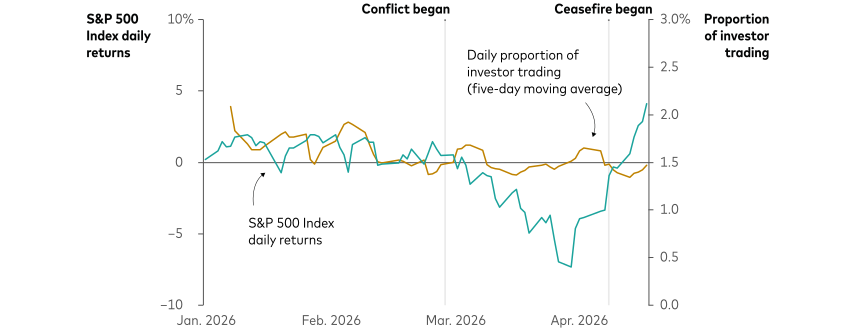
Notes:
Trading includes transactions involving investment options, excluding pure money movement in and out of an account. The proportion of investor trading is calculated based on Vanguard’s retail client base as of year-end 2025. (The figures show daily levels, so they will not match the monthly figures cited in the article.) Past performance is no guarantee of future returns. The performance of an index is not an exact representation of any particular investment, as you cannot invest directly in an index.
Sources: Federal Reserve Economic Data (FRED) for index data, and Vanguard for data on retail investor transactions from January 2 through April 17, 2026.
“Periods of market uncertainty can spark anxiety in the moment, but our data show that most investors respond with discipline rather than emotion,” said Andy Reed, Vanguard’s head of Behavioral Economics Research.
“Market swings rarely rattle Vanguard investors,” said Xiao Xu, a Vanguard investment strategy analyst. “Trading patterns were similar to April 2025 when we dealt with tariff volatility. Equity markets have now since returned to record highs.”
Buyers widely outnumbered sellers
Crucially, trading was tilted toward buying, not selling. Over the six weeks of the conflict, investors who traded were net buyers of equities by nearly a 4-to-1 margin.1 That buying interest persisted even on the most volatile days, suggesting rebalancing behavior rather than fear-driven exits.
“What stands out is not just how few investors traded, but how they leaned into volatility rather than away from it,” Xu said. “Time and again, Vanguard investors stayed the course and seized the moment.”
Time and again, when fear prevails, Vanguard investors bought the dip
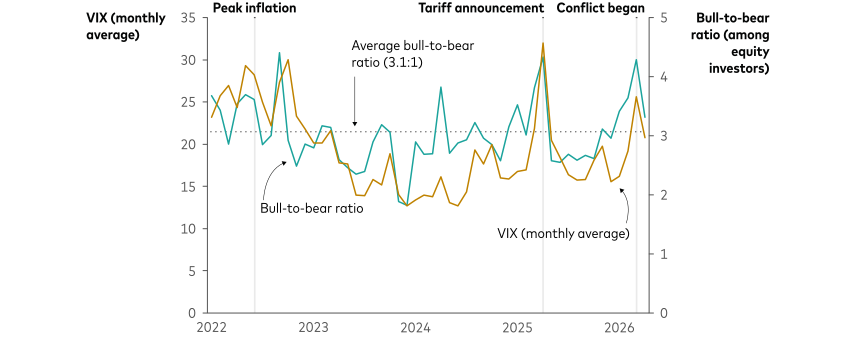
Notes: The bull-to-bear ratio is calculated by the ratio of the number of net buyers of equity and the number of net sellers of equity on a trading day. Daily figures were converted to a monthly average. VIX (the CBOE Volatility Index), sometimes called the “fear index,” is based on the prices of options on the S&P 500 Index and is a gauge of 30-day expected volatility of the U.S. stock market. Daily VIX levels were converted to a monthly average. Past performance is no guarantee of future returns. The performance of an index is not an exact representation of any particular investment, as you cannot invest directly in an index.
Sources: FRED for index data and Vanguard for data on retail investor transactions from January 1, 2022, through April 17, 2026.
Women traded less and bought more
Gender and age differences surfaced during the conflict.
Women were less likely to trade at all, with only 11% making trades compared with 16% of men. But among those who traded, women were more likely to be net buyers, with a higher bull-to-bear ratio (4:1) than their male counterparts (3:1).
"Staying the course continues to be a hallmark of long-term investing success,” said Fiona Greig, Vanguard’s global head of Investor Research and Policy. “Women are particularly coolheaded during market volatility and use it as an opportunity to buy the dip.”.
In addition, those who sold equities tended to be older, with a median age of 56, compared with 40 for net buyers and 48 for those who did not trade. This aligns with the reality that investors closer to retirement often have a lower tolerance for short-term swings, even when long-term plans remain intact.
Benefits of staying the course
Those who stayed invested through the volatility not only avoided locking in losses but also positioned themselves to capture the recovery that followed. Markets reward patience, and the data suggest that Vanguard investors understand this fundamental truth: The real risk isn't volatility itself, but abandoning a sound plan when the headlines turn dark.
1 Zooming out, during the market drawdown from January 27 to March 30, 17% of investors traded, twice as many as during the rapid recovery (8%) from March 31 to April 15. In both periods, most traders were net buyers, but buying was especially strong during the decline, with a bull-to-bear ratio of nearly 4-to-1 versus 3-to-1 in the rebound.


Notes:
All investing is subject to risk, including the possible loss of the money you invest.
Contributors