Investor outcomes
Discipline that delivers
There are numerous ways to assess investment performance. By any measure, we’re proud of our results.
Bettering long-term outcomes
Clients entrust their money to Vanguard in pursuit of financial security and their dreams. Our responsibility is to invest client assets with care and prudence.
In seeking to improve investor outcomes, we strive to provide investment returns that, with reasonable consistency and over the long term, exceed the average returns of competing funds with comparable policies and risk parameters. While low costs do not guarantee superior performance, the best-performing funds tend to be low in cost.1 And our funds and ETFs are among the lowest in cost.
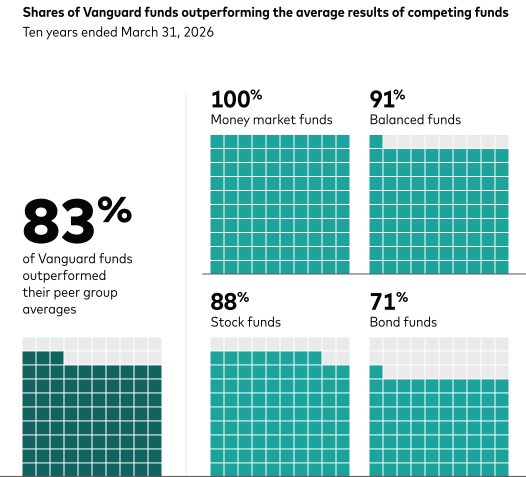
Notes: For the 10-year period, six of six money market funds, 77 of 108 bond funds, 21 of 23 balanced funds, and 172 of 196 stock funds, or 276 of 333 Vanguard funds overall, outperformed their peer-group averages. Results will vary for other time periods. Results for Vanguard and competing funds are net of fees. Only funds with a minimum 10-year history were included in the comparison. Note that the competitive performance data shown represent past performance, which is not a guarantee of future results, and that all investments are subject to risks. For the most recent performance, visit our website at www.vanguard.com/performance.
Sources: Vanguard, based on data from LSEG Lipper.
Technology’s growing role at Vanguard
Our technology agenda is driven by our commitment to protect our clients’ personal information, enhance their service experience, and improve their investment outcomes. We prioritize innovations that simplify and personalize client journeys and lower the cost of investing. Learn more.
An enviable record in active management
We brought indexing from the world of institutional investors into the portfolios of everyday investors. But our first funds were actively managed. The common thread between our lineups of index and actively managed funds is their low operating costs.
One sign of the strength of our active lineup is the performance of the funds versus their primary benchmarks, which are unmanaged market indexes. Unlike real-world portfolios, the funds’ benchmarks are theoretical constructs that incur no operating or transaction costs. While most competing active funds historically have underperformed, most of our active funds have outperformed.2
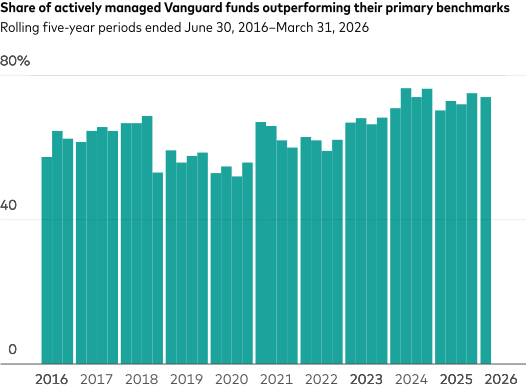
Notes: Each data point reflects the percentage of Vanguard’s actively managed U.S.-domiciled funds that outperformed their primary benchmarks during the preceding five years. Each data point is as of the end of a quarter. The funds’ primary benchmarks are various unmanaged market indexes. Past performance is not a guarantee of future results. The performance of an index is not an exact representation of any particular investment, as you cannot invest directly in an index.
Source: Vanguard.
1 See, for example, the cost section of Vanguard’s Principles for Investing Success, Vanguard, 2023.
2 Industrywide, 88% of U.S. stock funds, 79% of international stock funds, 78% of emerging market stock funds, 90% of global stock funds, and 51% of general investment-grade bond funds underperformed relevant, S&P-assigned benchmark indexes for the five years ended June 30, 2025. Source: S&P Dow Jones Indices, SPIVA U.S. Scorecard, available at https://www.spglobal.com/spdji/en/documents/spiva/spiva-us-mid-year-2025.pdf. Past performance is no guarantee of future returns. The performance of an index is not an exact representation of any particular investment, as you cannot invest directly in an index.
Notes:
For more information about Vanguard funds and Vanguard ETFs, visit vanguard.com to obtain a prospectus or, if available, a summary prospectus. Investment objectives, risks, charges, expenses, and other important information are contained in the prospectus; read and consider it carefully before investing.
Vanguard ETF Shares are not redeemable with the issuing fund other than in very large aggregations worth millions of dollars. Instead, investors must buy and sell Vanguard ETF Shares in the secondary market and hold those shares in a brokerage account. In doing so, the investor may incur brokerage commissions and may pay more than net asset value when buying and receive less than net asset value when selling.
All investing is subject to risk, including the possible loss of the money you invest.