Tax insights
A way to give to charity that can help reduce taxes
April 15, 2026
After age 70½, writing a check usually isn’t the most tax‑efficient way to support a favorite charity. Qualified charitable distributions (QCDs) allow eligible investors to give directly from an IRA to a qualified charity—and reduce their tax bill in the process. By keeping those dollars out of reported income, QCDs can help reduce the taxation of Social Security benefits, limit exposure to income‑based Medicare surcharges, and avoid other tax‑related costs.
In 2026, investors age 70½ and older can give up to $111,000 per year directly from a traditional IRA to a qualified charity through a QCD. The amounts donated count toward an IRA’s required minimum distributions without increasing an investor’s taxable income, and, for married couples, each spouse can make a QCD from their own IRA.
Which accounts are eligible for QCDs?
QCDs can be made from:
- Traditional IRAs.
- Inherited IRAs (also known as beneficiary IRAs).
- Inactive SEP-IRAs or SIMPLE IRAs.
Workplace retirement accounts such as 401(k), 403(b), and 457(b) plans are not eligible for QCDs. However, investors age 70½ and older can roll over assets from a workplace plan into an IRA, making a QCD an option. QCDs can also be taken from Roth IRAs, but there’s typically little benefit since qualified Roth withdrawals are already tax-free.
Why QCDs can be more effective than charitable deductions
Most people who take the standard deduction can deduct up to $1,000 if filing single, or $2,000 if married and filing jointly, unless they itemize deductions. Even for those who itemize, QCDs are different because they remove the IRA withdrawal from taxable income altogether. This can help investors:
- Pay less tax on Social Security benefits.
- Lower Medicare Part B premiums.
- Avoid losing other income-based tax breaks.
- Stay in a lower tax bracket for capital gains.
- Simplify Roth conversions without pushing income into a higher tax bracket.
Starting in 2026, charitable deductions can only be itemized for amounts above 0.5% of adjusted gross income (AGI). Also, those in the 37% marginal tax bracket will only be able to deduct charitable contributions as though they were in the 35% bracket. QCDs are not subject to these limits, which can make them especially valuable.
Examples of what QCDs look like in practice
Reducing taxes for a moderate-income couple. Terry and Kelly, both 75, have a total of $140,000 in income: $60,000 from Social Security, $20,000 in long-term capital gains, and $60,000 from IRA withdrawals. They want to give $50,000 to charity. By using a QCD instead of a traditional donation, they lower their taxable income enough that none of their Social Security benefits are taxed, while still taking the standard deduction. As a result, they save more than $5,400 in taxes and owe no federal income tax.
Preserving tax benefits at higher income levels. If Terry and Kelly wanted to make the same $50,000 donation but had an additional $60,000 in taxable income, using a QCD would save them even more. While their Social Security benefits remain taxable in this case, the QCD keeps them in a lower tax bracket, prevents their capital gains from being taxed, and preserves their full senior deduction, which would otherwise be partially phased out. They save more than $9,000 in taxes.
The tax effects of QCDs versus traditional donations
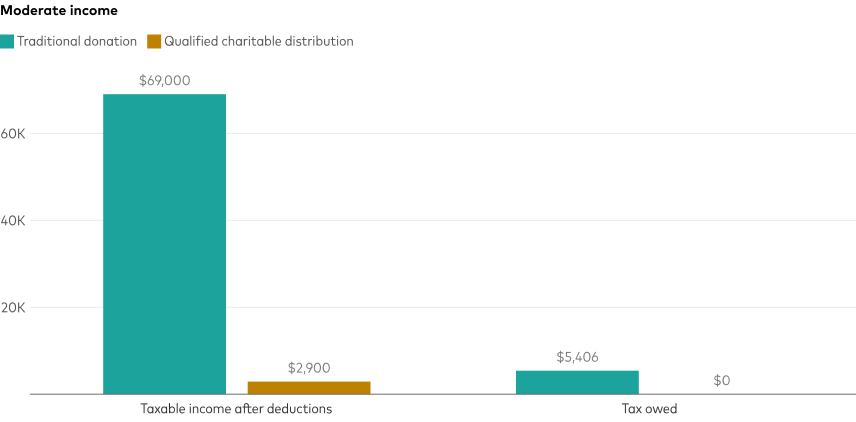
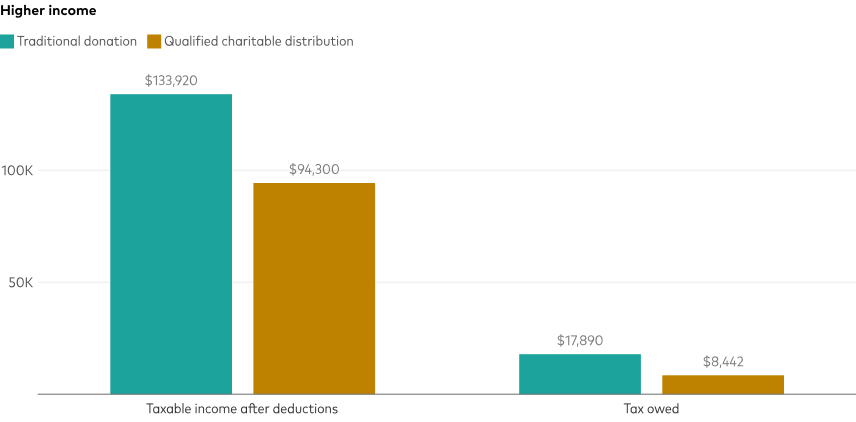
Notes: The moderate income figure assumes the investors are a married couple with $140,000 in income that want to make a $50,000 charitable gift, and the higher income figure assumes the investors are a married couple with $200,000 in income that want to make a $50,000 charitable gift. There are no other itemized deductions in either scenario.
Source: Vanguard.
How to use a QCD
While the specific steps to initiate a QCD may vary for different IRA custodians, here are the basic steps:
1. Confirm your eligibility. You must be 70½ or older at the time of the distribution.
2. Pick a qualified charity. The charity must be an IRS-approved 501(c)(3) organization. QCDs cannot be made into a donor-advised fund. However, a one-time donation of up to $55,000 can be made to a charitable remainder trust or charitable gift annuity.
3. Start the transfer. Ask your IRA provider to make a check payable to the charity. Your provider may mail the check to the charity or to you. Do not deposit or otherwise take possession of the funds.
4. Ensure delivery. Make sure the charity receives the check and ask whether any additional documentation is required.
5. Keep records. Your IRA provider will send you Form 1099-R. The charity should provide a written acknowledgement of the donation.
A more deliberate way to give in retirement
QCDs highlight an often overlooked truth of retirement planning: Small structural decisions can have sizable effects. By directing IRA withdrawals straight to charity, investors can support the causes they care about and navigate taxes more efficiently, bringing charitable intent and financial planning into closer alignment.


Notes:
All investing is subject to risk, including possible loss of principal.
Neither Vanguard nor its financial advisors provide tax and/or legal advice. This information is general and educational in nature and should not be considered tax and/or legal advice. Any tax-related information discussed herein is based on tax laws, regulations, judicial opinions, and other guidance that are complex and subject to change. Additional tax rules not discussed herein may also be applicable to your situation. Vanguard makes no warranties with regard to such information or the results obtained by its use and disclaims any liability arising out of your use of, or any tax positions taken in reliance on, such information. We recommend you consult a tax and/or legal advisor about your individual situation.
Certified Financial Planner Board of Standards Inc. owns the certification marks CFP®, CERTIFIED FINANCIAL PLANNER®, in the U.S., which it awards to individuals who successfully complete CFP Board's initial and ongoing certification requirements.
Contributor