Expert insight
TrumpIRA marketplace: What’s to like—and to consider
June 08, 2026


The TrumpIRA Executive Order proposes a new, government-backed marketplace—TrumpIRA.gov—designed to expand retirement saving among workers who lack access to an employer‑sponsored plan. Combining access, low costs, and a simplified investment menu, it would enable such workers to easily compare and open a low-cost IRA from participating financial companies.
Starting in 2027, the website would list financial institutions that offer IRAs with at least three key features: a simple menu of investment options typically offered in retirement plans (such as target-date funds), low fees, and no minimum balance or contribution requirement.
The order also calls for eligible workers who save in these accounts to receive a federal Saver’s Match, whereby the government contributes a 50% match up to $1,000 a year to their retirement savings.1
Finally, it asks the Department of the Treasury and the IRS to make it possible for people to receive charitable contributions into their accounts and to develop legislation to expand this effort.
Roughly 30% of private‑sector workers lack access to a workplace retirement plan.2 Federal efforts to expand coverage therefore represent an important step toward improving retirement readiness. The TrumpIRA Executive Order outlines an initial framework, with further details to be developed through regulation and potential legislation. Against that backdrop, we highlight what is most promising in the proposal—and what policymakers could consider to strengthen it over time.
What’s to like
1. More people saving for retirement and receiving contributions.
TrumpIRA.gov aims to make it easier for uncovered workers to open and fund an IRA, while increasing awareness of the Saver’s Match—a government contribution equal to 50% of eligible contributions, capped at $1,000 per year for qualifying individuals (and $2,000 for married couples filing jointly), subject to income limits. By centralizing information and enrollment, the marketplace could meaningfully increase participation rates among workers who might not otherwise engage with the retirement system.
This matters because access remains a binding constraint on retirement readiness. The Vanguard Retirement Outlook shows that only 42% of Americans are currently on track for retirement, and that access is decisive: Workers with access to an employer‑sponsored plan are nearly twice as likely to be on track for retirement as those without one. A national IRA marketplace could help narrow that gap.
2. An investment menu for IRAs—a step in the right direction.
The Executive Order requires participating providers to offer a simple menu of diversified investment options, explicitly including target‑date funds and other automatic portfolio options commonly used in employer plans. This is an important departure from the typical IRA experience, whereby investment choice is unconstrained and cash often becomes the default.
The structure of investment choices influences outcomes. Vanguard research shows that a significant share of IRA contributions and rollovers remain uninvested for extended periods: 28% of rollover balances stay entirely in cash for at least seven years, particularly among younger investors and those with smaller balances.3 By contrast, in workplace plans—where target‑date funds are often the default—roughly two‑thirds of participants are invested in professionally managed portfolios, and workers under age 40 hold nearly 90% of their assets in equities.4 Requiring a structured menu of IRAs helps close this gap.
IRA cash from direct contributions and rollovers is “sticky”
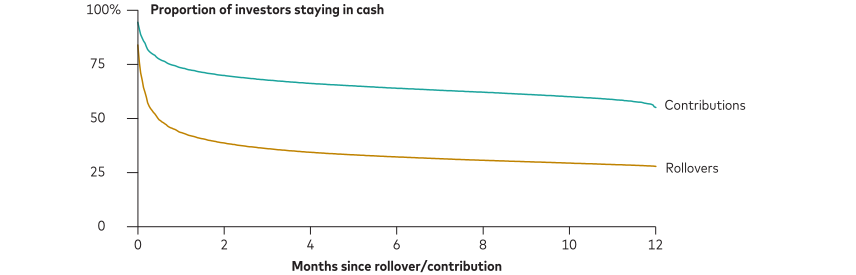
Notes: We considered direct contributions and rollovers that entered the account in cash. To minimize the number of cases where a second direct contribution occurred during the one-year period of study, we restricted our analysis of direct contributions to those of exactly $6,000 (the annual contribution limit in 2022). We also only considered clients who had a positive IRA balance at the end of 2023. The resulting sample size represented roughly 279,000 direct contributions and 290,000 rollovers.
Source: Vanguard analysis of rollovers and direct contributions into Vanguard IRAs in 2022.
3. Low costs matter.
The proposed 0.15% cap on all investment and account‑level fees is meaningful. A centralized marketplace can promote fee transparency and encourage the use of low‑cost products designed for long‑term retirement saving. Costs compound over time, and even modest differences can materially affect outcomes. As Vanguard founder Jack Bogle said, “In investing, you get what you don’t pay for.”
What to consider—a wish list to strengthen the TrumpIRA.gov marketplace
1. Establish a true investment default.
Offering a menu is a meaningful improvement, but defaults do the heavy lifting. Accounts opened through TrumpIRA.gov would be more effective if they included a designated default investment—such as an age‑appropriate target‑date fund—while preserving the ability to opt out.
Defaults are now standard in employer plans: Nearly all retirement plans administered by Vanguard designate a default, and 91% include a target‑date fund.5 Most workers stick with the default: 59% of participants are invested in a single target-date fund. The impact is substantial: For investors under age 55, defaulting rollovers into a target‑date fund rather than cash is associated with more than $130,000 in additional retirement wealth by age 65, with estimated systemwide benefits of more than $170 billion annually.6
Extending defaults to IRAs would address an important gap in retirement choice architecture.
2. Automatically enroll workers by facilitating payroll deduction.
The evidence is unequivocal: Automatic enrollment boosts participation rates dramatically. Participation rates are 30 percentage points higher in plans that auto-enroll their workers compared with those that don’t (94% compared to 64%).7 Voluntary enrollment leaves too much to individual action. Instead, adding opt-out enrollment would materially increase participation rates and balances, especially among lower- and moderate-income workers.
A federal framework could build on this experience by requiring employers that do not sponsor a plan to facilitate payroll deduction into IRAs, with opt‑out protections. State auto‑IRA programs demonstrate that structured coverage requirements can both increase saving and encourage some employers to adopt their own plans. Across 17 state auto‑IRA programs in effect, roughly 1.2 million savers nationwide have enrolled,8 and another 300,000 workers gained access as 30,000 additional employers decided to offer a retirement plan.9 This evidence suggests that a federal approach to expand access could complement—rather than displace—the private retirement system.
3. Make rollovers easier through digital infrastructure.
Rollovers remain one of the most friction‑filled moments in the U.S. retirement system, often relying on paper checks and manual processes. Policymakers could modernize this experience by promoting standardized, digital account‑to‑account transfers for all rollovers. Specifically, policymakers could establish standardized Automated Customer Account Transfer Service protocols to enable digital rollovers between and among retirement plans and IRAs.
International experience underscores the potential. Australia’s SuperStream infrastructure requires standardized data and electronic transfers, enabling rollovers to occur within days rather than weeks. Improving rollover “plumbing” in the U.S. would help workers preserve, consolidate, and stay invested in their retirement assets, reducing leakage and cash drag over time.
4. Expand the saving opportunity.
Even with the Saver’s Match, uncovered workers can save far less than those with access to an employer plan. IRA contribution limits ($7,500 for a person under 50) remain well below 401(k) contribution limits ($24,500), and employer matching contributions—which often equal 3% of pay or more—are unavailable.
Policymakers could consider modest, targeted expansions to IRA contribution limits or enhancements to the Saver’s Match (for example, higher caps or broader income eligibility), while preserving the advantages of the voluntary employer‑sponsored system. Carefully calibrated, such changes could strengthen retirement outcomes without undermining plan sponsorship.
The bottom line
The core strength of TrumpIRA.gov is structural: It combines access, low costs, a sensible investment menu, and a government match in an IRA framework tailored to uncovered workers. Its potential grows substantially with the addition of a true investment default, payroll‑based participation, digital rollovers, and expanded saving capacity. With these enhancements, the marketplace could move from a helpful alternative to a durable pillar of the U.S. retirement system.
1 The Saver’s Match (beginning in 2027) provides a federal matching contribution of up to 50% on the first $2,000 saved for retirement for low‑ and moderate‑income workers. The match phases down above certain income limits—roughly $20,000 to $35,000 for single filers and $40,000 to $70,000 for married couples filing jointly. Eligibility requires earned income and retirement contributions to IRAs or workplace plans.
2 U.S. Bureau of Labor Statistics, Employee Benefits in the United States—March 2025. As of March 2025, 28% of private industry workers lacked access to workplace defined contribution plans, according to a U.S. Department of Labor news release.
3 Andy Reed, Aaron Goodman, Fiona Greig, Ariana Abousaeedi, and Sachin Padmawar (2024). Improving retirement outcomes by default: The case for an IRA QDIA. Vanguard.
4 Vanguard, 2025. How America Saves.
5 Vanguard, 2025. How America Saves.
6 Andy Reed, Aaron Goodman, Fiona Greig, Ariana Abousaeedi, and Sachin Padmawar, 2024. Improving retirement outcomes by default: The case for an IRA QDIA. Vanguard.
7 Vanguard, 2025. How America Saves.
8 Georgetown University Center for Retirement Initiatives, 2026. State Program Performance Data.
9 Adam Bloomfield, Lucas Goodman, Manita Rao, and Sita Slavov, 2024. State Auto-IRA Policies and Firm Behavior: Lessons from Administrative Tax Data, NBER Working Paper 32817.


Notes:
All investing is subject to risk, including the possible loss of the money you invest.
Diversification does not ensure a profit or protect against a loss.
Investments in target-date funds are subject to the risks of their underlying funds. The year in the fund name refers to the approximate year (the target date) when an investor in the fund would retire and leave the workforce. The fund will gradually shift its emphasis from more aggressive investments to more conservative ones based on its target date. An investment in target-date funds is not guaranteed at any time, including on or after the target date.