Research summary
Taking an educated approach with active
September 02, 2026
Over the past decade, 529 plans have evolved from menus of basic investment options to sophisticated lineups featuring automated glide paths that adjust as beneficiaries age.
While Vanguard glide paths within 529 plans have been index-based, new Vanguard research, described in the paper Educated Alpha: A Path to Active for College Savers, outlines a framework for incorporating actively managed funds into these glide paths while keeping college savings front and center. In this way, 529 plans can offer more choice to current investors while also expanding their appeal to new investors who want the option of including active investments in their glide path.
When active meets goals-based investing
"Glide paths that solely use passive building blocks are fantastic, and they form the core of many Vanguard products," said Bryan Hassett, investment strategist at Vanguard and lead author of the paper. "But that doesn’t mean a great glide path can’t also include active management. Having this type of glide path available can give investors more choice, and it also—crucially—can meet the needs of those looking for different ways to reach their goals."
When building a glide path that includes active management, the researchers knew that meeting the needs of the investor would be the central tenet underlying the portfolio; active management would not be included just for the sake of including active management. In the Vanguard active Target Enrollment Portfolio glide path (which includes passive and active funds), the portfolio design starts with the Vanguard Life-Cycle Investing Model and focuses on what matters most: effectively funding education expenses. Using projections from the Vanguard Capital Markets Model®, the framework balances active risk with an investor’s comfort level around performance volatility.
Vanguard active Target Enrollment Portfolio glide path
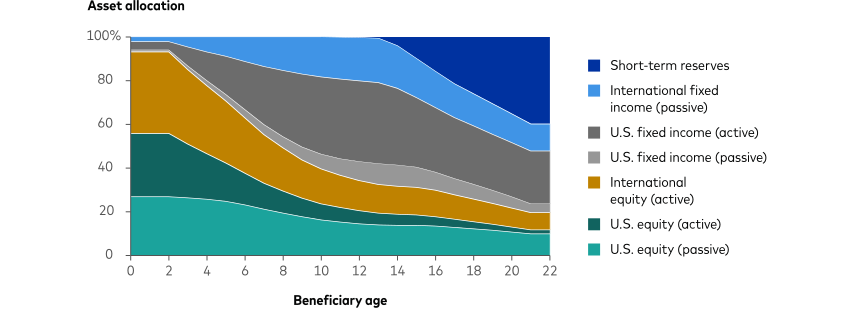
Note: The chart shows the portfolio allocation over time for the Vanguard active Target Portfolio glide path, with both active and passive equity and fixed income investments shown.
Source: Vanguard.
Early on, when the time horizon is longest, the portfolio carries higher equity exposure, holding a strategic mix of active U.S. equity, active international equity, and passive components. As college gets closer, the allocation gradually shifts toward fixed income—blending active and passive U.S. bonds with passive international bonds and short-term reserves. Throughout, the framework adjusts the active-passive balance based on time remaining and how much tracking error an investor would be willing to accept.
Checking the math on active
Projected outcomes can help keep us honest about whether our glide path could improve investors’ chances of meeting their goals. In running their simulations, the authors found that the active glide path supports better results at the median and in many downside scenarios. The active glide path also delivered a 7.38% median return versus 6.61% for the passive alternative.
There are trade-offs, however. Investors will encounter increased volatility with active glide paths, and there will be periods when active funds lag their benchmarks. Projections suggest a 3.6% absolute return lag in a downside scenario and underperformance in approximately 37.5% of simulated annual periods.1
These risks mean that glide paths with active investments aren’t for everyone. But for investors willing to tolerate the ups and downs relative to the benchmark, our framework offers a chance at higher upside while keeping their goals front and center.
The bottom line: Does active work in 529s?
As investor preferences continue to evolve, providers are exploring different paths to meet demand for active options. Vanguard’s framework offers one way to balance that demand with a goals-based design—keeping education funding at the center while giving families more options in their investment approach.
In the end, it’s still about the goal. "Saving for college should always be about saving for college," Hassett noted. "Whether you’re using fully passive investments, or blending in active management, the asset allocation should always be focused on helping the investor support their educational goals."
1 Calculated as the percentage of simulated years in our distribution of 22 years and 10,000 simulations (220,000 total events) where excess returns are less than 0.00%.



Notes:
All investing is subject to risk, including possible loss of principal. Be aware that fluctuations in the financial markets and other factors may cause declines in the value of your account. There is no guarantee that any particular asset allocation or mix of funds will meet your investment objectives or provide you with a given level of income.
The target enrollment portfolio is subject to the risks of the underlying stock funds, which include stock market risk, country/regional risk, currency risk, sector risk, and emerging markets risk, and the risks of the underlying bond funds, which include interest rate risk, income risk, prepayment risk, extension risk, call risk, credit risk, country/regional risk, liquidity risk, currency and currency hedging risk, and derivatives risk. The portfolio is also subject to investment style risk, index sampling risk, and nondiversification risk. For more information regarding the portfolio risk factors, please refer to the Explanation of the Risk Factors of the Portfolios section of the Program Description.
Contributors

Bryan Hassett