An open letter to investors
Our unwavering commitment to you
May 01, 2026
Topics
My fellow Vanguard investor-owners,
The past year had more than its fair share of uncertainty—in markets, in the economy, and for many, in your household finances. But at least one thing remained steadfast: Vanguard is your firm. You are our owners, and Vanguard is unambiguously on your side, focused on your long‑term success.1
I wrote to you last May to mark Vanguard’s 50th anniversary. This year, I am writing to welcome millions of new investor-owners to Vanguard, to highlight the resilience of your disciplined approach, and to share our progress on our mission to give you the best chance for investment success.
Markets performed well this past year, but not without bouts of uncertainty, volatility, and temptation. Yet, you did something hopeful, hard, and wise: You stayed true to your investment principles. While I am of course biased, I believe your focus on goals, balance, discipline, and cost distinguished you as the ultimate smart money investors.
You stayed focused on your goals
Clear goals anchor decisions when markets are full of sound and fury. Even as inflation and higher rates put pressure on household budgets, 45% of investors in Vanguard 401(k) plans increased their contribution rate, and most others held their contributions steady.2 As a result, the average rate of retirement savings in Vanguard plans rose to an all‑time high of 12% of income.3 In aggregate, you invested record levels of net new assets with Vanguard as you saw opportunities to get closer to your longer-term goals.
You kept a balanced and diversified mix of investments
In 1976, Jack Bogle launched the first index fund for individual investors, now known as the Vanguard 500 Index Fund, taking the first step toward making diversified, tax-efficient investing accessible to millions. Had you invested $10,000 in the fund back then, it would be worth roughly $2 million today.4
Fifty years later, you continue to follow Bogle’s maxim to “buy the haystack,” with the greater choice we now offer across our stock, bond, and balanced funds. Last year, for example, you put roughly half of your new investments into fixed income, adding diversity to your portfolios. Many of you—including those who rely on us for advice and those who invest in our Target Retirement Funds—also benefited from diversification across global markets.
You stayed the course, maintaining long-term discipline
While all major asset classes delivered positive returns in 2025, market fluctuations felt much more choppy in any given week, including recently. Into this mix, the siren songs of speculation grew louder, providing ample opportunity for investors to flinch.
You stayed the course and stayed invested, a time-tested way to build wealth for the long term. During tariff‑related volatility last April, 93% of Vanguard investors chose patience over panic and kept their portfolios unchanged. Among those who did trade, you chose to invest more rather than pull back by a factor of 5:1. This year, in the wake of stock, bond, and energy price volatility resulting from conflict in the Middle East, your steady, buy-and-hold behavior mirrored that of years past.
You kept your costs low
As we announced in February, we lowered fees again, trimming our average annual fund operating cost to 0.06%, or $6 per $10,000 invested. The rest of the fund industry still charges an average of 0.44%, pocketing more than seven times our fees.5 Combined with the fee cuts we announced in 2025, that’s an estimated $600 million dollars of savings for investors that will compound over time.6
Fee cuts are one way in which you, as owners, participate in our growing economies of scale. We are also making record levels of investment in our client experience as outlined later in this letter.
Lower fees reflect our belief that in investing you get what you don’t pay for. Costs matter, not just because of what you save but also in the performance of your funds. Low fees and strong performance aren’t opposites—they go together, as shown in the chart below.
Morningstar recently estimated that Vanguard investors benefited from “nearly $5 trillion of income and gains” over the last decade, thanks largely to disciplined investing on your part that allowed you to “participate more fully” in your funds’ returns.7
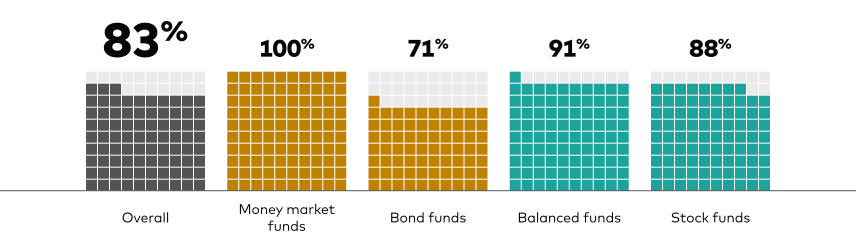
Over the ten years ended March 31, 2026, the overwhelming majority of Vanguard funds outperformed their peer‑group averages. These strong results reflect our low operating costs, the expertise of our index and active portfolio managers, and your discipline in staying invested for the long term.
Share of Vanguard funds that have outperformed the competition8
Ten years ended March 31, 2026
Sources: Vanguard calculations, based on data from LSEG Lipper and Morningstar.
We take pride in what we have helped you achieve with your investments, but we find purpose in finding additional areas where we can extend “The Vanguard Effect” to improve the quality of what the asset and wealth management industry offers while lowering the price and increasing access.
We have been focused on three areas where we saw meaningful opportunity to improve your chances of investment success: getting better performance from your fixed income investments—particularly active fixed income; earning better yields from your cash savings; and increasing the accessibility, quality, and personalization of advice and guidance especially when aided by AI.
Better performance in fixed income at a lower cost
Fixed income is a critical part of your portfolio, providing stability and income that becomes more important as you approach retirement. Fixed income markets are also complex and inefficient, providing opportunities for active management to outperform. But for too long, Wall Street has been selling a narrative that to get the outperformance that active fixed income can deliver, investors need to pay much higher fees—exactly when retirees can least afford them.
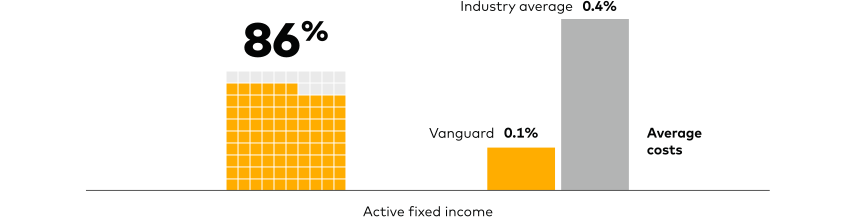
It’s a false dichotomy. We charge an average of 10 basis points for active fixed income management, while our peers charge four times that.9 Lower fees are a reason for our outperformance, because having a lower fee threshold allows our portfolio managers to be more disciplined about risk and generate better long-term outcomes. Case in point: 86% of Vanguard’s active fixed income funds have outperformed peers over the past decade, and 100% of them are priced in the lowest cost decile.10
Share of Vanguard active fixed income funds that have outperformed the competition
Ten years ended March 31, 2026
Sources: Vanguard calculations, based on data from LSEG Lipper and Morningstar.
We built our fixed income business 45 years ago to take a stand for investors—starting in active, expanding into index, and today ranking among the top managers in both.11 We will continue to broaden our lineup, especially in active fixed income, where we see the greatest opportunity to lower the cost and raise the bar on performance.
Helping your savings earn better yields
Our goal is to help your savings grow through investing. Still, there are moments when holding cash can play an important role in providing flexibility for major purchases, security for unforeseen expenses, and balance within a long‑term plan.
Savers deserve a better deal than they are getting today from most wealth and asset managers on their cash. Our money market funds, often used for cash allocation in an investment portfolio, charge about half the industry average fee, allowing you to earn more.12
But you also told us you were tired of getting next to nothing when you needed to hold cash in a traditional savings account. We launched Cash Plus Accounts a few years ago with bank partnerships to provide higher yields (currently eight times the average bank savings yield13) and FDIC insurance.14 Since then, over half a million of you have opened Cash Plus Accounts—some as a basic emergency fund alongside your Vanguard 401(k), some for the convenience of money movement like paying bills,15 but most just to get a fairer deal than what the industry offers.
Later this year, you will see expanded ways you can use Cash Plus to transfer your money or make payments. We’re also enhancing the value we deliver for clients who prefer to hold cash. Whether you want to keep your cash in money market funds, savings accounts, or both, paying close attention to your cash yields can make a meaningful impact to your overall outcomes. It’s where many firms look to profit at your expense. We are determined to make better cash savings solutions more widely available.
An advisor in every investor’s pocket
High-quality financial advice shouldn’t be a luxury good. Today, only one out of five Americans work with a fee-based financial advisor.16 Fiduciary advisors are in short supply and are typically focused on high-net-worth individuals, leaving most people underserved. The problem will compound as large numbers of advisors are expected to retire in the coming years. We’re also seeing long-time self-directed investors come to us for help as they face new circumstances—such as managing retirement income, navigating tax events, or spouses taking the lead on household investment decisions.
Vanguard’s Advisor’s Alpha® research over the last 25 years found that advisors following wealth management best practices can help clients achieve better outcomes. More than half of U.S. investors are also using or seriously considering using generative AI for financial guidance.17 You have told us that you want AI support, but that you are looking for something more trusted, more personalized, and more private than what is available today.
Earlier this year, we made our AI-enabled Expert Insights tool available to advisors—those who work at Vanguard as well as registered investment advisors who use Vanguard funds—to put the expertise of Vanguard’s portfolio analysis specialists directly in advisors’ hands. It is the latest in a range of AI tools we’ve added to enable our growing ranks of Vanguard advisors to spend more time with you and support you with even more personalized care.
For investors who prefer getting their support digitally, we have Vanguard Digital Advisor. Investors with as little as $100 can get access to advice at a fee of 0.15% (a fraction of the industry average).18
Later this year, we’ll pilot our new AI capability for Digital Advisor that connects directly to your portfolio and financial plan. You’ll get clear, insightful answers from it, personalized to how you like to interact with your finances, and of course rooted in Vanguard’s proven methodology. With launch planned for early next year, this new tool will deliver personalized investment advice across a broad range of topics. Our goal is to increase access to advice, putting an advisor in every investor’s pocket, grounded in our time-tested principles for investing success.
Making sure our service always meets your expectations is at the top of my list.
You should always feel that Vanguard is right alongside you, so even as we lower fees, we are making record investments to make it easier to get the support you need and the experience you deserve, whether delivered digitally or through our crew.
We are near completion of a multiyear, multibillion-dollar investment to modernize our technology infrastructure, including the systems behind our website and mobile app, so they work together reliably, intuitively, and securely. We are also stepping up investments in several places where you will see and feel the difference in your experience with us.
Over the next few months, we will launch a refreshed website that brings your entire relationship with Vanguard together in one place—clearly and simply—with the information you have told us you want. This site was shaped by feedback from thousands of investors who tested it with us. Thank you if you were one of them.
We are expanding our chat capabilities on the site and on mobile—which now serves more than two million investors per month—and enhancing both with AI-enabled features that will answer your questions whenever you have them. You’ll see your finances with an intuitive, personalized experience.
And when you need a person, not a screen, help should be available and effective. We’ve increased the number of trained representatives taking your calls by nearly 20%. More calls—now 85%—are resolved in a single conversation, and we are focused on getting that number even higher. We’ve also added dedicated service support that stays with you through the most deeply personal moments like navigating an inheritance or rolling over your retirement savings to the next job or the next chapter.
For investors with higher assets and more complex needs, we are bringing back a more personalized tier of service under the Flagship® name. Since joining Vanguard, I’ve heard consistently from investors who valued the client care Flagship stood for.
Beginning later this year, eligible investors for Flagship service will start to see enhanced support, including more access to service teams, financial consultants, and education resources aligned to life stages and goals, along with a differentiated approach to Cash Plus and partner benefits as relationships deepen. As this next chapter of Flagship service rolls out, our focus is on delivering flexible, personal, and responsive support.
All these efforts reflect our continued commitment to improving your experience and giving you the best chance for investment success.
A better experience also means having a voice. With Vanguard Investor Choice, more than 22 million equity index fund investors can choose how their share of those funds is voted at public company meetings—and we are committed to extending that option to all U.S. equity index fund investors over time.
In a couple months, the United States will mark 250 years since an audacious idea was declared in Philadelphia—that ordinary people could build a fair system and shape their own future.
Benjamin Franklin gave early voice to that ideal and extended it further, arguing that financial independence wasn’t a privilege reserved for those born into wealth. Rather, it ought to be within the reach of every American who worked hard and saved effectively, ensuring that the system worked for, not against, them.
Two centuries later, that same idealism drove Jack Bogle to found Vanguard—just outside Philadelphia in Valley Forge. His revolutionary idea was that an investor-owned company that takes a stand for you—that is dedicated to giving you a fair shake—would improve your chances of investment success and make the system of investing better for everyone.
Neither experiment will ever be finished. But both have endured because they are rooted in hope and renewed by work.
Our crew put Bogle’s idealism into practice every day, applying discipline, judgment, humanity, and a long‑term mindset to the work behind your investments and service. We will continue to pursue our mission, in service of your interests, with tenacity and with the same zeal that has defined us for more than half a century.
Thank you again for your trust in us and in Vanguard.
Salim Ramji
Chief Executive Officer
Related content
1 Vanguard is owned by its funds, which are owned by Vanguard's fund shareholders.
2 Vanguard 401(k) plan data on changes in contributions and the average rate of deferral are as of December 31, 2025, and are from Previewing How America Saves 2026.
3 Source: Vanguard.
4 The growth of $10,000 is the hypothetical cumulative wealth of an initial $10,000 investment in Vanguard 500 Index Fund Investor Shares from December 31, 1976, through March 31, 2026. Returns are calculated from monthly fund total returns, net of fees and assumes the reinvestment of all dividends. For one-, five-, and ten-year performance data for Vanguard 500 Index Fund, visit our website. Past performance is no guarantee of future returns.
5 The Vanguard and industry-excluding-Vanguard average expense ratios are asset-weighted, based on assets under management in all U.S-domiciled mutual funds and ETFs as of December 31, 2025. Sources: Vanguard and Morningstar, Inc.
6 Estimate of aggregate client cost savings reflect assets under management as of November 30, 2024, for fee cuts announced in early 2025, and December 31, 2025, for cuts announced in early 2026. There is no guarantee that any individual investor will save money due to the reductions in expense ratios. Figures are estimates and should not be relied on. For illustrative purposes only. Savings due to the reduction in expense ratios were calculated on a share class basis for each fund for which there is a Vanguard-initiated reduction. To estimate 2026 savings, 2025 year-end AUM was multiplied by the 2026 reduced expense ratio.
7 Source: Vanguard Investors Cleaned Up | Morningstar.
8 For the 10-year period ended March 31, 2026, 6 of 6 Vanguard money market funds, 77 of 108 bond funds, 21 of 23 balanced funds, and 172 of 196 stock funds, or 276 of 333 Vanguard funds overall, outperformed their peer group averages. Results will vary for other time periods. Only U.S.-domiciled funds with a minimum 10-year history were included in the comparison. The competitive performance data shown represent past performance, which is not a guarantee of future results. All investments are subject to risks. For the most recent performance, visit vanguard.com/performance.
9 The average expense ratio for actively managed, non-Vanguard fixed income mutual funds and ETFs is 0.4%, four times the equivalent Vanguard expense ratio of 0.10%. Vanguard and competing fixed income fund universes include money market funds, as well as taxable and tax-exempt bond funds for both retail and institutional investors. Source: Vanguard calculations using Morningstar data. Expense ratios weighted by assets as of December 31, 2025.
10 For the ten-year period ended March 31, 2026, 51 of 59 share classes of Vanguard money market and actively managed bond funds outperformed their peer group averages. Results will vary for other time periods. Only funds with a minimum ten-year history were included in the comparison. Source: Vanguard. The competitive performance data shown represent past performance, which is not a guarantee of future results. All investments are subject to risks. For the most recent performance, visit vanguard.com/performance.
11 As of March 31, 2026, Vanguard managed more than $515 billion in actively managed bond mutual funds and ETFs and more than $1.5 trillion in bond index funds, making it the largest manager of both types of funds, according to data from Morningstar.
12 The expense ratios of Vanguard money market funds ranged during their most recent fiscal years—various 12-month periods that ended in the latter half of 2025—from 0.08% (for our Treasury Money Market Fund) to 0.13% (California Municipal Money Market Fund). As of year-end 2025, the industry average expense ratios, excluding Vanguard, were 0.24% for tax-exempt money market funds and 0.25% for taxable money market funds, according to data from Morningstar.
13 The Vanguard Cash Plus bank sweep program APY (annual percentage yield) is 3.35% as of 4/29/2026. The APY will vary and may change at any time. Source for average bank savings yield of 0.38%: FDIC National Rates and Rate Caps as of 4/20/2026. Bank savings accounts offer different services and features than a Vanguard Cash Plus Account. For example, savings accounts often offer features like overdraft protection, ATM access, bill pay services and other conveniences that Cash Plus Accounts do not offer. Cash Plus Accounts allow you to hold certain securities that bank savings accounts cannot hold. In addition, Cash Plus Accounts are subject to fraud prevention restrictions such as holding periods and transaction limits, which may not apply to a bank savings account. There may be other differences between these products that you may want to consider before choosing which option is best for you.
14 Bank Sweep program balances are held at one or more Program Banks, earn a variable rate of interest, and are not securities covered by SIPC. They are not cash balances held by Vanguard Brokerage Services (VBS), a division of Vanguard Marketing Corporation (VMC); VMC is not a bank. Balances are eligible for FDIC insurance subject to applicable limits and certain conditions. FDIC insurance only covers failure of the Program Banks. See the Vanguard Bank Sweep Products Terms of Use and Vanguard Bank Sweep Program Bank List on vanguard.com for more information.
15 Some third-party institutions may not accept the Cash Plus Account routing number for transactions. If you have any issues using the routing number on a third-party website, contact the provider. Your account may be subject to various restrictions to reduce the risk of fraud. Your transactions may be subject to a 7-day holding period as well as daily transaction limits. Generally, new accounts will be subject to a 60-day holding period for cash and check deposits. During this time, you can invest with this cash, but cash deposits into your account may only be returned to the bank account from which the cash was withdrawn. After the holding period is complete, your funds will be fully available to transfer or withdraw.
16 Vanguard Investment Advisory Research Center estimate that one out of five Americans works with a fee-based financial advisor is based on a variety of third-party research. Northwestern Mutual estimates that 34% of the general population works with a financial advisor (What Can Millionaires Teach Us About Financial Planning?), while YouGov offers a slightly lower estimate (27% of Americans use financial advisors, with 60% prioritizing trust as the top factor). We assume the actual figure is 30%, then multiply that estimate by 75%—which is the share of financial advisors who are fee-based, according to Cerulli Associates (More Than 72% of Financial Advisors Are Compensated by Fee-Based Models).
17 See, for example, AI Financial Advice: Supply, Demand, and Life Cycle Implications.
18 According to Morningstar's 2025 Robo-Advisor Report, the average advisory fee charged on a hypothetical $15,000 balance by 16 digital advisory services, including Vanguard Digital Advisor, was 0.3%, and the median fee was 0.25%. Note that some providers may charge flat monthly fees, which are not reflected in the average or median industry fees, instead of or in addition to asset-based fees.
Vanguard Digital Advisor charges brokerage accounts an annual gross advisory fee in the amount of 0.20% for an index portfolio option or 0.25% for an active portfolio option. That gross advisory fee is reduced by a credit of the actual revenue The Vanguard Group, Inc., or its affiliates retain from investments in each enrolled account, resulting in a net advisory fee. The net advisory fee is the actual fee collected from your account(s) and will vary based on your unique asset allocation, portfolio option, account type, and specific holdings in each enrolled account. Note that this fee doesn't include investment expense ratios charged by a fund, such as fees paid to the funds' third-party managers which are not credited. While we generally recommend using low-cost Vanguard funds to build your portfolio, actively managed funds will have higher expense ratios than index funds. For more information on the services, find VAI's Form CRS and each program's advisory brochure here for an overview.


IMPORTANT INFORMATION:
For more information about Vanguard funds, visit vanguard.com to obtain a prospectus or, if available, a summary prospectus. Investment objectives, risks, charges, expenses, and other important information are contained in the prospectus; read and consider it carefully before investing.
All investing is subject to risk, including possible loss of principal. Be aware that fluctuations in the financial markets and other factors may cause declines in the value of your account. There is no guarantee that any particular asset allocation or mix of funds will meet your investment objectives or provide you with a given level of income.
Diversification does not ensure a profit or protect against a loss.
Bond funds are subject to the risk that an issuer will fail to make payments on time, and that bond prices will decline because of rising interest rates or negative perceptions of an issuer's ability to make payments.
Investments in stocks or bonds issued by non-U.S. companies are subject to risks including country/regional risk and currency risk. These risks are especially high in emerging markets.
Investments in Target Retirement Funds are subject to the risks of their underlying funds. The year in the Fund name refers to the approximate year (the target date) when an investor in the Fund would retire and leave the workforce. The Fund will gradually shift its emphasis from more aggressive investments to more conservative ones based on its target date. The Income Fund has a fixed investment allocation and is designed for investors who are already retired. An investment in a Target Retirement Fund is not guaranteed at any time, including on or after the target date.
The Vanguard Cash Plus Account is a brokerage account offered by Vanguard Brokerage Services, a division of Vanguard Marketing Corporation, member FINRA and SIPC. Under the Sweep Program, Eligible Balances swept to Program Banks are not securities: they are not covered by SIPC, but are eligible for FDIC insurance, subject to applicable limits. Money market funds held in the account are not guaranteed or insured by the FDIC, but are securities eligible for SIPC coverage. See the Vanguard Bank Sweep Products Terms of Use and Program Bank list for more information.
Treasury Money Market Fund:
You could lose money by investing in the Fund. Although the Fund seeks to preserve the value of your investment at $1.00 per share, it cannot guarantee it will do so. An investment in the Fund is not a bank account and is not insured or guaranteed by the Federal Deposit Insurance Corporation or any other government agency. The Fund’s sponsor is not required to reimburse the Fund for losses, and you should not expect that the sponsor will provide financial support to the Fund at any time, including during periods of market stress.
California Municipal Money Market Fund:
The Fund is only available to retail investors (natural persons). You could lose money by investing in the Fund. Although the Fund seeks to preserve the value of your investment at $1.00 per share, it cannot guarantee it will do so. The Fund may impose a fee upon the sale of your shares. An investment in the Fund is not a bank account and is not insured or guaranteed by the Federal Deposit Insurance Corporation or any other government agency. The Fund’s sponsor is not required to reimburse the Fund for losses, and you should not expect that the sponsor will provide financial support to the Fund at any time, including during periods of market stress.
Advice services are provided by Vanguard Advisers, Inc., a registered investment advisor, or by Vanguard National Trust Company, a federally chartered, limited-purpose trust company.