About indexing
Learn more about what index funds are, the advantages they offer to investors, and how indexing continues to evolve.
- Returns since 1976
- How it works
- Key benefits
- Range of choice
- Indexing videos
Returns since 1976
How it works
Key benefits
Range of choice
Indexing videos
A source of impressive returns
What if you’d put $10,000 in what’s now called Vanguard 500 Index Fund back in 1976?
Thanks to the power of compounding, that investment could have grown to roughly $2.0 million by March 2026, highlighting the transformative potential of index funds over time.
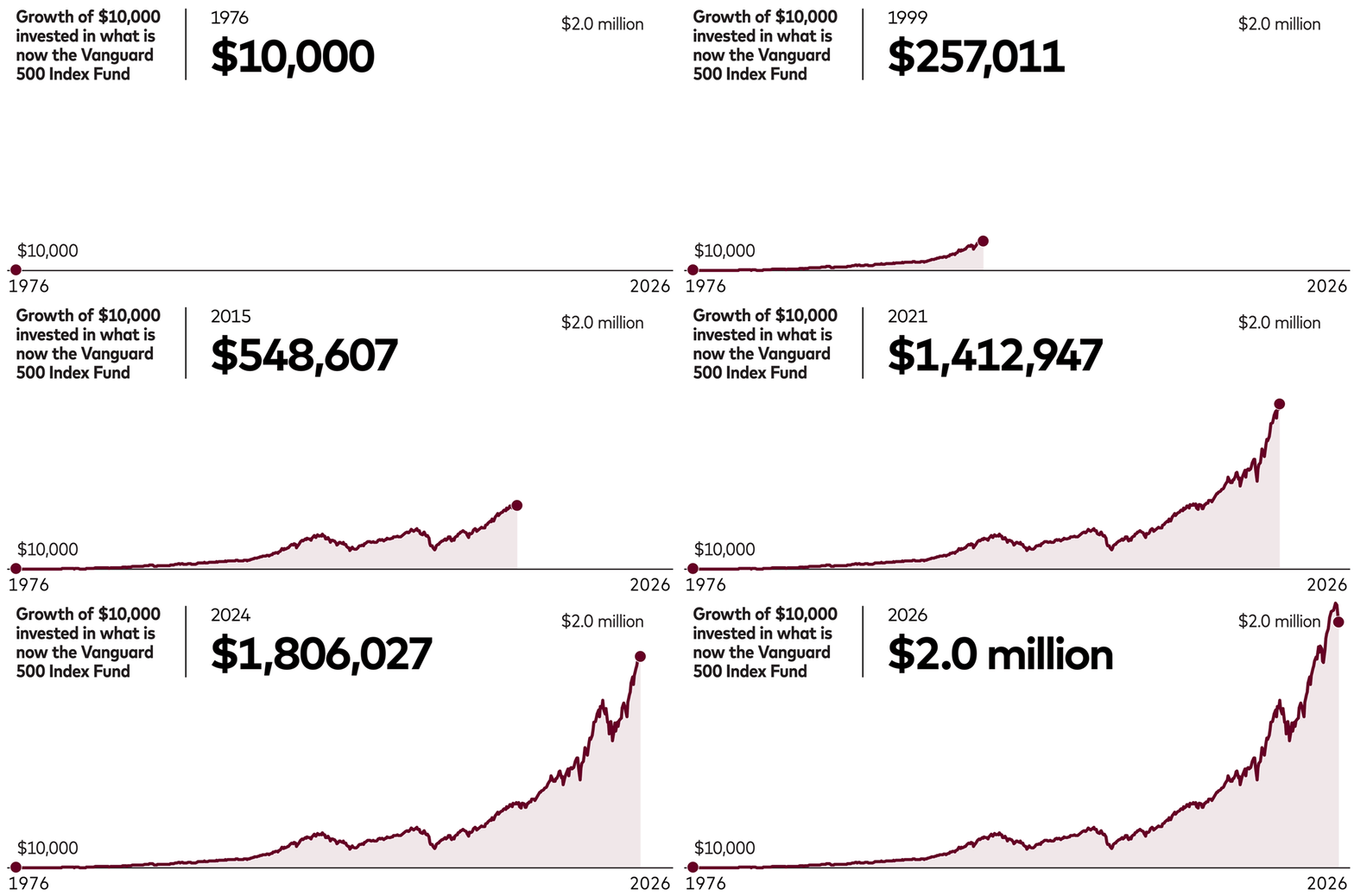
Notes: The chart shows the hypothetical cumulative wealth of an initial $10,000 investment in Vanguard 500 Index Fund Investor Shares from December 31, 1976, through March 31, 2026. Returns are calculated from monthly fund total returns, net of fees. The performance data shown represent past performance, which is not a guarantee of future results. Investment returns and principal value will fluctuate, so investors’ shares, when sold, may be worth more or less than their original cost. Current performance may be lower or higher than the performance data cited. The performance of an index is not an exact representation of any particular investment, as you cannot invest directly in an index. For performance data current to the most recent quarter-end and month-end for Vanguard 500 Index Fund Investor Shares (VFINX), visit our website.
Sources: Vanguard calculations, using data from Morningstar, Inc.
What is an index fund?
An index fund seeks to track a specific benchmark, like the S&P 500 Index, as closely as possible. Rather than relying on analysts or fund managers to pick the securities they think are going to outperform, an index fund simply aims to consistently deliver benchmark-like returns and transparency about what you’re invested in.
"Don't look for the needle in the haystack. Just buy the haystack!"
John C. Bogle
Vanguard's founder
You can invest in index funds through a mutual fund or ETF structure.
How index funds are built
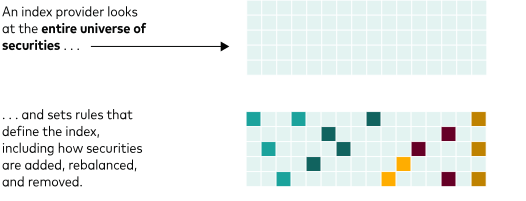
Essentially, an index is a rules-based bucket of investments designed by an index provider to represent a specific market, segment, or investment idea.
Index provider constructs the index
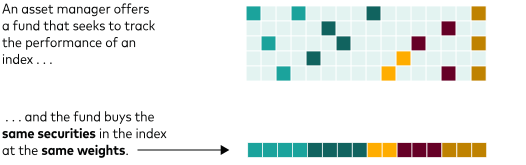
An index mutual fund or ETF is designed by an asset manager to replicate the performance of a target index.
Asset manager constructs the index fund
How index funds are helping investors
Index funds have transformed investing for more than 50 years by making it easier and more affordable to build a diverse portfolio.
Making it possible for anyone to have a well-diversified portfolio
Directly owning at least one share of each stock in the S&P 500 Index and maintaining market cap proportions would cost around $3.2 million.1
Making saving for retirement and college easier and more affordable
Today, most retirement plans and 529 college savings plans offer index funds or use indexing as a core building block.
That broad adoption has enabled Americans to retain more of their hard-earned money. Our estimate shows that, in the last 25 years alone, investors could have collectively saved an astounding $570 billion in fees.
How much index funds could have saved investors in fees since 2000
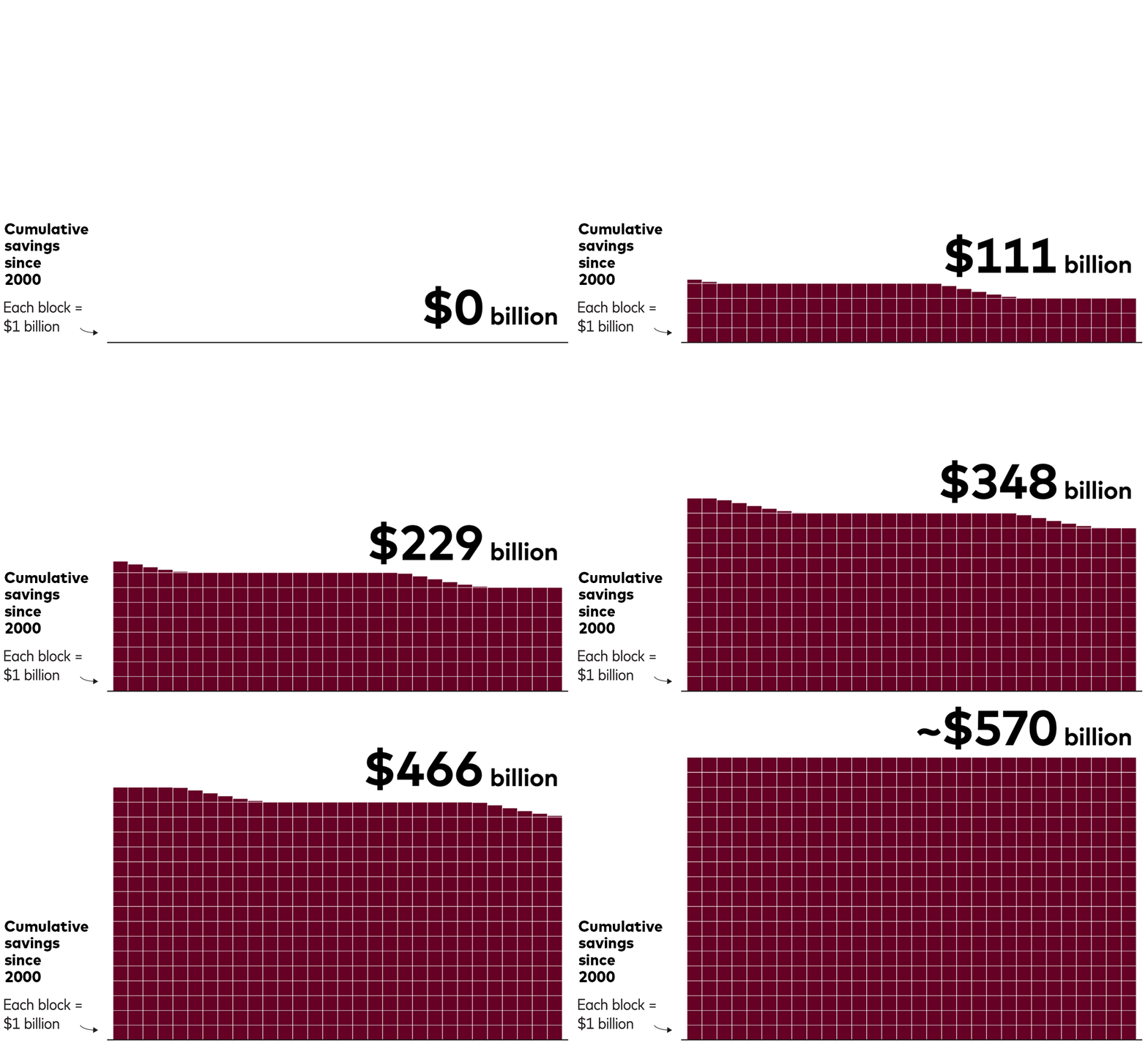
Notes: Data are as of December 31, 2025, for U.S.-domiciled mutual funds and ETFs, based on annual report net expense ratios. In this hypothetical example, we assume that, if index funds had not existed, index investors would have invested in active funds charging the then-prevailing, asset-weighted average active fund expense ratio. Data reflect the difference between the cumulative expense ratio fees paid by investors owning open-end funds and what they would have paid if index funds didn’t exist. Investor savings are calculated as: (asset-weighted expense ratio of actively managed funds multiplied by industry assets) minus (asset-weighted expense ratio of index funds multiplied by industry assets).
Sources: Vanguard calculations, using data from Morningstar, Inc.
1 Vanguard calculations, based on data from Bloomberg, as of November 30, 2025.
Key benefits of indexing
Index funds offer several key benefits that can help build a stronger, more diversified portfolio. Let’s explore what makes them such a powerful option.
Confidence through consistency
Index funds deliver consistent performance by mirroring their benchmark—not trying to beat it. That reliability gives investors a powerful foundation for long-term stability and disciplined asset allocation.
Built-in diversification
Index funds offer smart, scalable risk mitigation. They can spread investment risk across securities and sometimes sectors—minimizing volatility from any single stock or industry.
Lower cost
With minimal overhead and trading, index funds cost less to manage, which means more of the return stays where it belongs—with the investor. Even a fraction of a percentage point on a fund’s overall expenses adds up over time, so keeping costs low is key for investment growth.
Easy to understand
Clear objectives and a simple structure. Index funds are precisely designed to track the performance of a specific index, so investors know exactly what they are investing in.
Tax efficiency
Less trading means fewer taxable events. For investors in taxable accounts, indexing can help preserve gains and minimize erosion from capital gains taxes. It’s a way of controlling costs that you can’t always see—taxes.
Power of low-cost investing
Costs matter and so does the power of compounding. Indexing offers a low-cost investment option (both through lower expense ratios and tax efficiency). Lower fees mean investors keep more of their returns, which compounds over time and helps improve long-term outcomes.
Indexing is a valuable starting point for all investors. While many investors may choose to index their entire portfolio, an allocation to active funds may also be suitable. Especially if the active funds can be accessed at a low cost.
Index funds, risk, and compounding: Investing basics
In this episode of In My Finance Era, Vanguard’s personal finance video podcast, Andy Reed, head of behavior economics research, explains the basics of index funds and how diversification can help reduce single stock risk. He also breaks down the power of compounding and explores the different types of investment risk. For more episodes of In My Finance Era, please visit: In My Finance Era: A Personal Finance Podcast | Vanguard.
How indexing has evolved
When index fund investing started, there was only one player in town: the S&P 500 Index. For many years, index fund investing was virtually synonymous with tracking what became known as “America’s index,” anchoring millions of portfolios to the benefits of broad diversification, cost efficiency, and precision.
But as markets have matured and investor preferences have shifted, the popularity of indexing has resulted in thousands of benchmarks with distinct security compositions.
This expansion of index strategies enables more precise portfolio construction aligned with investor goals and preferences.
Index fund strategies today offer a mosaic of choices
Notes: The chart depicts the total U.S. assets in U.S. dollars of U.S.-domiciled equity index mutual funds and ETFs, annually from December 31, 1976, to December 31, 2024. Funds are grouped into 12 mutually exclusive categories. The U.S. Total Market category comprises any fund whose primary prospectus benchmark is a total market index, such as the Russell 3000 Index or Wilshire 5000 Index, or any fund that otherwise indicates total market coverage in its fund legal name or prospectus. Funds not in the U.S. Total Market category are U.S. nontotal market funds and comprise the remaining 11 categories. The S&P 500 category comprises any U.S. nontotal market fund whose primary prospectus benchmark is the S&P 500 Index or any fund that otherwise indicates it tracks the S&P 500 Index in its fund legal name or prospectus. Any U.S. nontotal market fund that does not track the S&P 500 Index is categorized according to its Morningstar U.S. category group: Sector equity funds are categorized as U.S. Sector Equity and U.S. equity funds are categorized according to their Morningstar category as one of U.S. Fund Small Value, U.S. Fund Small Growth, U.S. Fund Small Blend, U.S. Fund Mid-Cap Value, U.S. Fund Mid-Cap Growth, U.S. Fund Mid-Cap Blend, U.S. Fund Large Value, U.S. Fund Large Growth, or U.S. Fund Large Blend.
Sources: Vanguard calculations, using data from Morningstar, Inc., and FactSet, as of December 31, 2024.
Building blocks for tailored portfolios
Indexing options include targeting specific sectors, styles, market-capitalization segments, factors, and regions. The shift from a single-fund strategy to index-based building blocks allows individual and institutional investors to construct balanced, low-cost portfolios built on index funds—without losing the diversification and affordability that made index fund investing transformative in the first place.
Indexing 101
This four-part video series explores the fundamentals of indexing, including what an index fund is, the potential benefits of indexing, how index funds work behind the scenes, and how investors can use them as part of a long-term investment strategy.
What is an index Fund?
An index fund is a simple way to invest in the market without picking individual stocks. Instead, the investor buys shares of an index fund, which itself holds shares of the stocks or bonds in the market index it tracks.
This video explains what an index fund is and how it works, including how it tracks a market index like the S&P 500 and helps investors diversify across many companies at once.
What’s included:
- What an index fund is and how it differs from stock picking.
- What it means to track an index like the S&P 500.
- How diversification helps spread risk across many investments.
- Why index funds are often considered low-cost.
Read transcript
When people think about investing, they often imagine trying to find the right stock. What's that one company that will outperform all the others? But that approach can often feel a lot like searching for a needle in a haystack. You might find it. You might not. John Bogle, founder of Vanguard, offered a different idea. He said, "Don't look for the needle in the haystack. Just buy the haystack." And that is what indexing is all about.
An index fund is a way to buy that haystack by investing in many companies at once, instead of trying to pick individual stocks. It does this by tracking an index, like the S&P 500, which represents the performance of the 500 largest publicly traded companies in the US. You can also invest in indexes that track other markets. By investing in this way, you're helping to spread out or diversify risk. You're not relying on the growth of a single company. You're utilizing the strength of an entire index.
Because indexing is not about stock picking or frequent trading, they often cost less to manage. This helps keep costs low. And low costs are key for investment growth. And that's the idea behind indexing. Own the haystack and stay focused on the long term.
Benefits of indexing
Indexing is a simple investment approach focused on broad market exposure, lower costs, and long-term consistency.
This video explains the key benefits of indexing and why many investors prefer a strategy that avoids constant stock picking and market timing.
What’s included:
- Why indexing reduces the need to guess or time the market.
- How lower trading can help reduce costs.
- How diversification spreads risk across many companies.
- Why staying invested matters for long-term growth.
Read transcript
Investing can often feel overwhelming, full of decisions about what to buy, how much to pay, and when to act. But what if it didn't have to be so complicated? That's what makes indexing so appealing to so many investors.
Indexing starts with keeping costs low. Index funds don't rely on stock-picking or frequent trading by portfolio managers. That helps keep expenses low. And over the long term, that means more of an opportunity to compound over time.
Diversification is another benefit. With a single index fund you can own hundreds or even thousands of companies at once. That spreads out the risk instead of betting on just a few stocks.
Indexing is also designed to be easy to understand and transparent. Index funds follow clear, rules-based benchmarks. But what is a benchmark? It's the index a fund is built to track, for example, the S&P 500. This benchmark represents the 500 largest publicly traded companies in the US. Because the goal of indexing is to match the market rather than to beat it, index funds give investors a consistent way to participate in long-term market growth.
With clear objectives and a simple structure, indexing helps you understand exactly what you're buying - diversified investing at a low cost.
How an index fund works behind the scenes
Index funds are designed to track the market, but what actually happens behind the scenes?
This video explains how index funds work, including how portfolio managers keep funds aligned with a benchmark like the S&P 500, and why trading still occurs in passive investing.
What’s included:
- How index funds track a benchmark.
- What “weights” and “alignment” mean.
- Why index funds still trade.
- How managers balance tracking accuracy and costs.
Read transcript
You might be wondering what happens behind the scenes when you invest in an index fund. My job is to keep the fund lined up with its benchmark, and ensure costs remain low. So what does that really mean?
It means we start with the benchmark; the index the fund is designed to track, like the S&P 500, for example. Then, we build the fund to look like the benchmark and hold the same companies at the same weights or proportions as the index. Our benchmark stays consistent most of the time, but it could change if a new company comes to the market, or one company buys another.
As a portfolio manager, my job is to make sure that no matter what happens, our funds continue to look like their benchmarks. We follow the markets, not the hype. Even when the benchmark stays the same, the funds continue to change as clients move money in and out.
I balance all of these things on behalf of our investors. Indexing takes discipline: tracking the benchmark, monitoring cash flows, and keeping everything aligned carefully and efficiently.
How investors can use an index fund
Index funds are widely used as the building blocks of long-term investment portfolios.
This video explains how real investors use index funds in their portfolios and retirement accounts and how index funds can help create a diversified portfolio.
What’s included:
- Where index funds fit in a portfolio.
- How they’re used in 401(k), IRA, and 529 plans.
- How to choose an index fund.
- Why costs and diversification matter.
Read transcript
For more than 50 years, index funds have helped transform investing, making it easier and more affordable to build a diversified portfolio. That's why investors use index funds, to help achieve various goals, like retirement, or college savings.
You can choose from a range of index funds designed to track different parts of the market. This can help you build a portfolio that reflects your needs, while still benefiting from diversification and low costs.
Choosing an index fund typically starts when you decide which part of the market you want to track. From there, you can look at the fund's objective, which explains what it's designed to do.
Next, don't forget to review the index fund's costs since lower expenses can help you keep more money invested over time.
And finally, index funds are used as part of a broader portfolio, sometimes on their own, sometimes alongside other investments. For many investors, this approach offers a simple, disciplined way to participate in the market over the long term.
Important information:
All investments are subject to risk, including the possible loss of the money you invest.
Diversification does not ensure a profit or protect against a loss.
Learn more

Below you’ll find our latest insights and research on index fund investing.
Index Funds, Risk, & Compounding: Investing Basics
Indexing: The engine powering retirement in America
50 years. 50 facts. Indexing since 1976
A bond index fund’s balancing act: Tracking error and cost
Making the implicit explicit: A framework for constructing active-passive portfolios
How index funds can help Americans build wealth
Setting the record straight: The truths about index fund investing
Notes:
For more information about Vanguard funds and ETFs, visit vanguard.com to obtain a prospectus or, if available, a summary prospectus. Investment objectives, risks, charges, expenses, and other important information are contained in the prospectus; read and consider it carefully before investing.
Vanguard ETF Shares are not redeemable with the issuing Fund other than in very large aggregations worth millions of dollars. Instead, investors must buy and sell Vanguard ETF Shares in the secondary market and hold those shares in a brokerage account. In doing so, the investor may incur brokerage commissions and may pay more than net asset value when buying and receive less than net asset value when selling.
All investing is subject to risk, including the possible loss of the money you invest.
Diversification does not ensure a profit or protect against a loss. Be aware that fluctuations in the financial markets and other factors may cause declines in the value of your account. There is no guarantee that any particular asset allocation or mix of funds will meet your investment objectives or provide you with a given level of income.
Bond funds are subject to the risk that an issuer will fail to make payments on time and that bond prices will decline because of rising interest rates or negative perceptions of an issuer's ability to make payments.
Investments in stocks or bonds issued by non-U.S. companies are subject to risks including country/regional risk and currency risk.