Account security
Phishing exploits the gap between tools and trust
May 07, 2026
A routine alert appears on a phone or computer—an account notification, a delivery update, a password reset prompt. These messages are now a common part of daily digital life. What may appear to be a single prompt may be a phishing attempt, designed to trigger action and, in some cases, initiate long-term financial exploitation built on a false sense of trust, familiarity, and sustained contact.
Phishing is no longer confined to suspicious emails tucked into an inbox. Today, these attempts surface across multiple devices and digital environments where routine interactions happen. Examining these prompts in context shows how phishing functions as an evolving system of influence, not an isolated digital nuisance.
How phishing occurs (and why it persists)
Phishing is a deceptive attempt to persuade someone to share sensitive information or grant access by impersonating a trusted source. Rather than relying on technical complexity, these schemes often exploit familiarity and routine, seeking credentials, verification codes, financial information, or permission to install software.
Despite years of awareness efforts, phishing is still one of the most frequently reported forms of internet crime in the United States.1 Its persistence reflects both technical gaps and the ways in which routine behavior and time pressure are exploited. Phishing spans a spectrum from broad, high-volume efforts to targeted spear phishing that draws on personal details to build credibility.
What phishing looks like today
Today’s phishing attempts span a wide range of channels and formats, mirroring how people interact with financial and everyday services across devices and platforms. These attempts often use signals of legitimacy, including branding, tone, and context, to align with routine activity. Common forms include:
- Emails sent from addresses that closely resemble financial institutions, retailers, or service providers.
- Phone calls displaying masked or spoofed caller IDs that appear to originate from official organizations.
- Text messages (“smishing”) tied to account activity, deliveries, or password resets.
- Pop-ups or in-app prompts that mimic security warnings and urge immediate action.
The defining feature in all these variations is not the surface-level instruction, but the request for access itself.
Why phishing can be difficult to recognize
These attempts succeed not because people fail to pay attention, but because they’re designed to blend into familiar routines and expectations. Effective attempts often rely on cues that feel familiar or plausible such as:
- Recognizable logos and institutions.
- Timing that aligns with common life events such as travel, new devices, or account changes.
- Urgency or authority that discourages verification.
- Conversational or casual language, particularly in text messages.
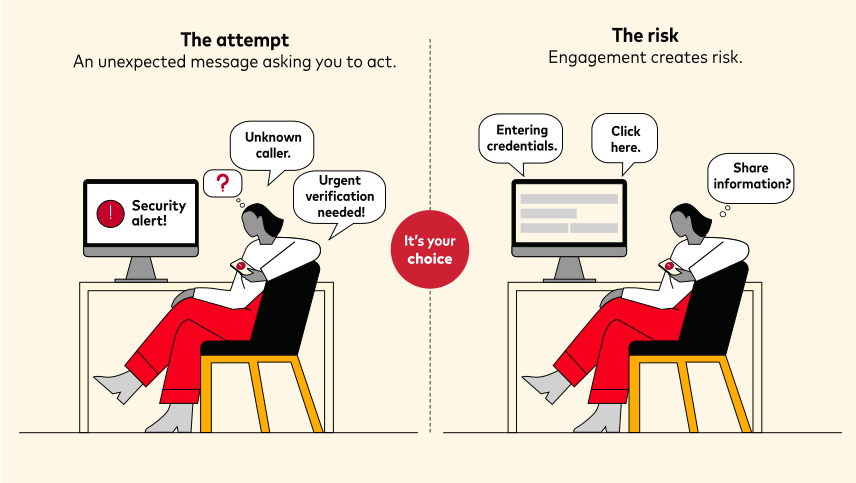
A phishing attempt is the message itself. The risk occurs when clicking, sharing, or responding.
The attempt versus the risk
Source: Vanguard
A message, call, or alert may seem routine, but its purpose is to draw engagement. The risk increases when a person responds by giving fraudsters a path to continue the interaction. Even small actions can signal access and lead to further attempts, turning a single prompt into an opening for broader exploitation over time.
When phishing escalates into exploitation
While phishing is often framed as a single event, it can also mark the starting point for broader scams that evolve over time. In many cases, escalation is not driven by the message itself, but by the response—small actions that signal availability, trust, or willingness to continue the exchange. Escalation may include:
- Ongoing contact that extends well beyond the initial message.
- Increasing personalization that often incorporates life details or prior interactions.
- Heightened pressure, including claims of urgency, risk, or exclusivity.
- Platform shifts, such as requests to move conversations from email or text to encrypted messaging apps.
- Requests to keep the interaction private, sometimes framed as a precaution or special instruction.
For example, a casual greeting via text can continue to ongoing contact, platform shifts, and increasing personalization. Over time, what starts as a low-stakes exchange may prove to be a sustained effort to influence behavior that could result in significant financial loss.
Digital hygiene as a risk-reduction framework
While updates, strong passwords, and multifactor authentication play an important role in preventing unauthorized access, phishing and other exploitation ultimately hinge on engagement. Choosing not to respond to unsolicited messages and navigating directly to trusted websites or apps when verification is needed can significantly reduce exposure.
Common digital hygiene practices include:
- Avoiding links or attachments in unexpected messages.
- Deleting or reporting suspicious messages rather than engaging.
- Keeping operating systems and applications current.
- Applying the same standards across all devices.
When messages are designed to create urgency, a brief pause can be a powerful countermeasure. Effective responses often follow a simple sequence:
- Pause before acting.
- Analyze what is being requested.
- Consult someone trusted, especially when situations feel time-sensitive or unclear.
Introducing a second perspective can help disrupt isolation and identify red flags that are harder to spot alone.
Phishing awareness and digital hygiene are most effective when part of a combined effort. As scams continue to adapt across platforms and devices, the greatest risk often emerges in the speed of the response rather than the message itself. By pausing, verifying all information through trusted channels, and maintaining consistent habits across devices, investors can significantly reduce the likelihood that a routine prompt becomes something more serious.
1 Source: Internet Crime Report 2025, Federal Bureau of Investigation, 2025; available at ic3.gov/AnnualReport/Reports/2025_IC3Report.pdf.


Notes:
All investing is subject to risk.