Expert insight
An optimistic but measured outlook for private equity
February 17, 2026
Successful stakes entail discipline, diversification, flexibility with liquidity and rigorous manager selection.
Highlights
- Private equity investments face several near-term challenges, but over the coming decade, we expect that high-quality managers with reasonable fees will deliver high-single-digit annualized returns, outperforming public equities.
- Investors should prioritize rigorous manager selection and diversification because of the high level of manager risk, partnering with firms that secure lower costs.
- Investors should also commit to a consistent private equity investment strategy and maintain flexibility with liquidity.
Private equity managers are navigating a challenging backdrop, with elevated borrowing costs and constrained exit opportunities. Secondary market volume—that is, the trading of fund interests—has risen. At the same time, discounts to net asset value have held steady, while fundraising has slowed amid the exit backlog. Despite this environment, our long-term outlook for high-quality private equity funds remains positive.
Dispersion of fund returns is likely to stay wide
Public equity returns have been strong, and private equity assets have grown significantly, but private equity funds in the top two quartiles of long-term performance have continued to deliver excess returns (Brown et al., 2024). While the asset-weighted return of buyout funds has underperformed a public index over the past few years, short-term stretches like this are not new (Rabinovich and Schweitzer, 2025). Despite the private equity industry’s maturation, the dispersion of excess returns remains significantly wider than for public equity funds and is at an absolute level close to historical norms, underscoring the continued importance of high-quality manager selection.
High-quality manager selection remains critical given high PE fund dispersion
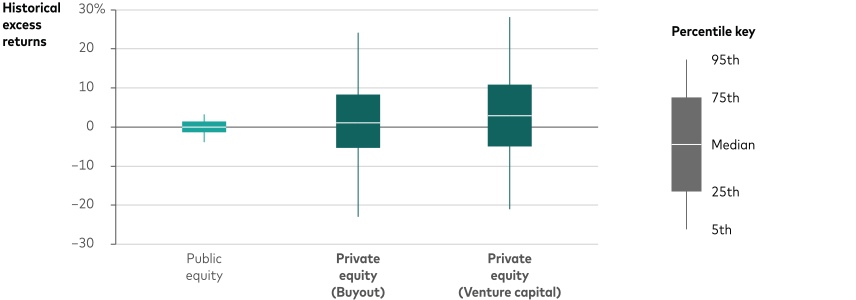
Notes: Analysis of public equity funds is based on their annual net-of-fee excess return over each fund’s benchmark, using 10 years of global active fund performance data as of Dec. 31, 2024. Calculations use net-of-fee data for private equity funds from vintage year 1998 to 2024. Excess returns are annualized and represented by “Direct Alpha.” Direct Alpha is an annualized measure of excess return that compares the performance of a private investment with the hypothetical return of a public market index, assuming an identical cash-flow pattern. Direct Alpha for buyout is computed against the Russell 3000 Index, and venture capital is computed against the Russell Microcap Index. For details on the methodology used to calculate Direct Alpha, see Gredil, Griffiths, and Stucke (2023). Past performance is not a guarantee of future results. The performance of an index is not an exact representation of any particular investment, as you cannot invest directly in an index.
Sources: Vanguard calculations, using data from Morningstar Inc. and MSCI.
Valuation spreads remain reasonable
Valuations remain elevated across private and public markets, but the spread continues to support the case for a private equity liquidity risk premium. In addition, secondary market volume for investors who demand liquidity continues to provide attractive opportunities for skilled managers to find high-quality assets at attractive prices.
Fees may be sticky without negotiating power
Fees directly affect investment returns, yet despite the tendency in other markets for fee percentages to decline as assets grow, private equity fund fees have remained relatively stable (Callan, 2024). Firms that negotiate lower management fees can boost net performance for investors.1
Valuations for private companies are attractive compared with public markets
Notes: The global buyout EV/EBITDA multiple is computed as the equal-weighted average of the median global buyout multiples of enterprise value to earnings before interest, taxes, depreciation, and amortization, as reported by Preqin and PitchBook. While these databases cover distinct sets of deals, some overlap may exist. Averaging across both sources provides a more representative estimate of prevailing valuation levels. Global and U.S. public equity valuations are based on the MSCI ACWI Investable Market Index and the Standard & Poor’s 500 Index, respectively.
Sources: Preqin, PitchBook, and FactSet data, as of September 30, 2025.
Earnings growth will be critical
Given stretched absolute valuations, future returns hinge on earnings growth rather than multiple expansion. With leverage less attractive in a higher-interest-rate environment, private equity managers are prioritizing organic growth, operational improvements, and strategic acquisitions for their portfolio companies. We expect reasonable corporate earnings growth of approximately 5% annually in the U.S. and about 4% globally over the next decade.2
Putting it all together: Forecast
Vanguard’s public equity return outlook for the next decade, particularly in the U.S., is cautious, with a wide range of possible outcomes. In comparison, the net-of-fee forecast for higher-quality private equity funds remains appealing, although the range of possible outcomes is wider given the inherent illiquidity and active risk. If investors gauge the risk of private equity investing by the average volatility of quarterly private equity fund net asset values, they might believe that private equity is safer than the public markets. However, we believe that this measure is artificially low and understates true risk. Our estimates in the chart below suggest the volatility is broadly comparable to that of public equity markets, aligning with theoretical expectations.
Private equity is likely to outpace public markets
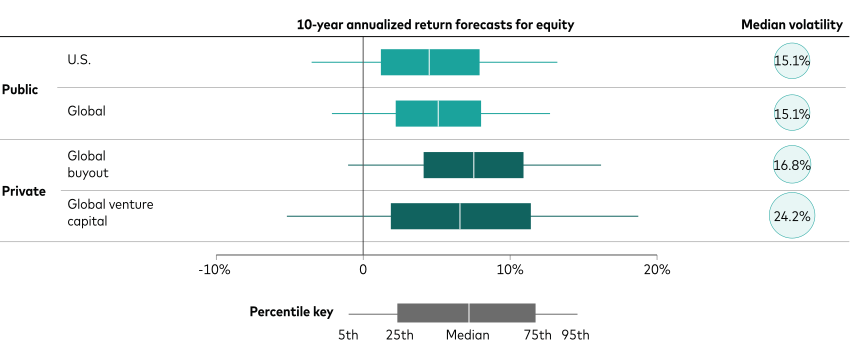
Notes: These return assumptions depend on current market conditions and may change over time. The PE return expectations are net of fund fees and assume zero manager alpha and a typical risk profile when a diversified program of funds is held. If an investor were able to identify and access high-quality managers with reasonable fees, a task that is challenging and carries significant uncertainty, that would shift the distribution to the right accordingly.
Sources: Vanguard calculations, using data from the MSCI-Burgiss Private Capital Universe sample and asset-return projections from the Vanguard Capital Markets Model (VCMM).
IMPORTANT: The projections and other information generated by the VCMM regarding the likelihood of various investment outcomes are hypothetical in nature, do not reflect actual investment results, and are not guarantees of future results. Distribution of return outcomes from the VCMM are derived from 10,000 simulations for each modeled asset class. Simulations are as of October 31, 2025. Results from the model may vary with each use and over time. For more information, please see the related notes at the end of this article.
Bottom line
Despite elevated levels of economic uncertainty, we remain positive on the long-term outlook for high-quality private equity funds. Our view is supported by historical performance, fair relative valuations and reasonable earnings growth expectations.
Given the manager and liquidity risks inherent to private equity investing, discipline, diversification, flexibility with liquidity and rigorous manager selection remain critical. Considering there is no guarantee of outperformance, the expected return premium must be high enough to compensate for these risks (Aliaga-Díaz et al., 2022). These factors make private equity unsuitable for some investors. For those who choose to pursue private equity, diversifying across managers, strategies, vintages and regions, sticking to a consistent private equity commitment strategy and partnering with a firm that can negotiate attractive fees can help improve the likelihood of achieving investment success.3,4
1 For more on the topic of fee variation within private equity funds, see Begenau and Siriwardane (2024).
2 For more information on our general corporate earnings growth outlook, see the Vanguard economic and market outlook for 2026, available at: https://corporate.vanguard.com/content/dam/corp/research/pdf/isg_vemo_2026.pdf.
3 For more on the topic of diversification within private equity, see Benefits of a Fund-of-Funds Strategy in Private Equity (Vanguard, 2024), available at https://corporate.vanguard.com/content/dam/corp/research/pdf/benefits_of_a_fund_of_funds_strategy_in_private_equity.pdf.
4 For more on the topic of consistent private equity commitment over the temptations of timing, see Power in Persistence: Staying the Course With Private Equity Commitments (Rabinovich, 2024), available at https://corporate.vanguard.com/content/dam/corp/research/pdf/power_in_persistence_staying_the_course_with_private_equity_commitments.pdf.



Notes:
All investing is subject to risk, including the possible loss of the money you invest. Diversification does not ensure a profit or protect against a loss.
This communication is for informational purposes only and does not constitute an offer or solicitation to purchase any investment solutions or a recommendation to buy or sell a security, nor is it to be construed as legal, tax or investment advice. Private investments involve a high degree of risk and therefore should be undertaken only by prospective investors capable of evaluating and bearing the risks such an investment represents. Investors in private equity generally must meet certain minimum financial qualifications that may make it unsuitable for specific market participants.
CFA® and Chartered Financial Analyst® are registered trademarks owned by CFA Institute.
More about the Direct Alpha methodology
Direct Alpha refers to the Gredil, Griffiths, Stucke Direct Alpha method. It is a measure of annualized excess return and compares the relative performance of the private market investment with the stated index as of the measurement date; the calculation is an internal rate of return, based on the series of fund cash flows and the residual value, discounted to a single point in time using the respective index returns; the cash flows are discounted to the same point in time to effectively eliminate the impact of any changes in the stated public equity index from the private market cash flows. For example, a direct alpha of 3.5% indicates that the private investment has generated an annualized excess return of 3.5% over the stated index.
About the Vanguard Capital Markets Model
The asset-return distributions shown here are in nominal terms—meaning they do not account for inflation, taxes, or investment expenses—and represent Vanguard’s views of likely total returns, in U.S. dollar terms, over the next 10 or 30 years; such forecasts are not intended to be extrapolated into short-term outlooks. Vanguard’s forecasts are generated by the VCMM and reflect the collective perspective of our Investment Strategy Group. Expected returns and median volatility or risk levels—and the uncertainty surrounding them—are among a number of qualitative and quantitative inputs used in Vanguard’s investment methodology and portfolio construction process. Volatility is represented by the standard deviation of returns.
IMPORTANT: The projections and other information generated by the VCMM regarding the likelihood of various investment outcomes are hypothetical in nature, do not reflect actual investment results and are not guarantees of future results. VCMM results will vary with each use and over time.
The VCMM projections are based on a statistical analysis of historical data. Future returns may behave differently from the historical patterns captured in the VCMM. More importantly, the VCMM may be underestimating extreme negative scenarios unobserved in the historical period on which the model estimation is based.
The Vanguard Capital Markets Model® is a proprietary financial simulation tool developed and maintained by Vanguard’s primary investment research and advice teams. The model forecasts distributions of future returns for a wide array of broad asset classes. Those asset classes include U.S. and international equity markets, several maturities of the U.S. Treasury and corporate fixed income markets, international fixed income markets, U.S. money markets, U.S. municipal bonds, commodities, and certain alternative investment strategies. The theoretical and empirical foundation for the Vanguard Capital Markets Model is that the returns of various asset classes reflect the compensation investors require for bearing different types of systematic risk (beta). At the core of the model are estimates of the dynamic statistical relationship between risk factors and asset returns, obtained from statistical analysis based on available monthly financial and economic data from as early as 1960. Using a system of estimated equations, the model then applies a Monte Carlo simulation method to project the estimated interrelationships among risk factors and asset classes as well as uncertainty and randomness over time. The model generates a large set of simulated outcomes for each asset class over time. Forecasts represent the distribution of geometric returns over different time horizons. Results produced by the tool will vary with each use and over time.
The VCMM’s primary value is its utility in analyzing potential investor portfolios. VCMM asset-class forecasts—comprising distributions of expected returns, volatilities and correlations—are key to the evaluation of potential downside risks, risk-return trade-offs and the diversification benefits of various asset classes. Although central tendencies are generated in any return distribution, Vanguard stresses that focusing on the full range of potential outcomes for the assets considered is the most effective way to use VCMM output.
The VCMM seeks to represent the uncertainty inherent in forecasting by generating a wide range of potential outcomes. The VCMM does not impose “normality” on expected return distributions but rather is influenced by the so-called fat tails and skewness of modeled asset-class returns. Within the range of outcomes, individual experiences can be quite different, underscoring the varied nature of potential investment outcomes. Indeed, this is a key reason why we approach asset-return outlooks in a distributional framework.
Indexes for VCMM simulations
The returns of our hypothetical portfolios are based on data for the appropriate market indexes as of October 31, 2025. We chose these benchmarks to provide the most complete history possible, and we apportioned the global allocations to align with Vanguard’s guidance in constructing diversified portfolios.
Asset classes and their representative forecast indexes are as follows:
U.S. equities: MSCI U.S. Broad Market Index.
Global equities (unhedged): MSCI All Country World Index.
Contributors