Research summary
How inheritance changes lives
September 22, 2026
The Great Wealth Transfer is underway: By 2048, roughly $100 trillion is expected to transfer from older generations to younger heirs, making inheritance an increasingly important part of household finances.1
For many Americans, an inheritance is the largest financial windfall they will ever receive. Yet the impact of an inheritance depends on more than its size, as described in Vanguard’s latest research paper, Transferring Wealth with Wisdom. “The financial and emotional benefits to heirs depend on when they receive their inheritance, what their balance sheets look like, and how they use the money,” said Ekaterina Goncharova, Vanguard investment strategy analyst and lead author of the paper.
Peak inheritance arrives long after peak debt
Inheritance typically arrives when heirs are in their early sixties, decades after their most financially challenging years. This is because the vast majority of heirs (97%) receive inheritance after the grantor passes away, not during their lifetime. But individuals’ debt burdens tend to peak much earlier, in their thirties and forties, when many are balancing expenses like mortgages, childcare, education costs, and retirement saving.
Inherited IRAs typically arrive after heirs’ peak debt-burden years
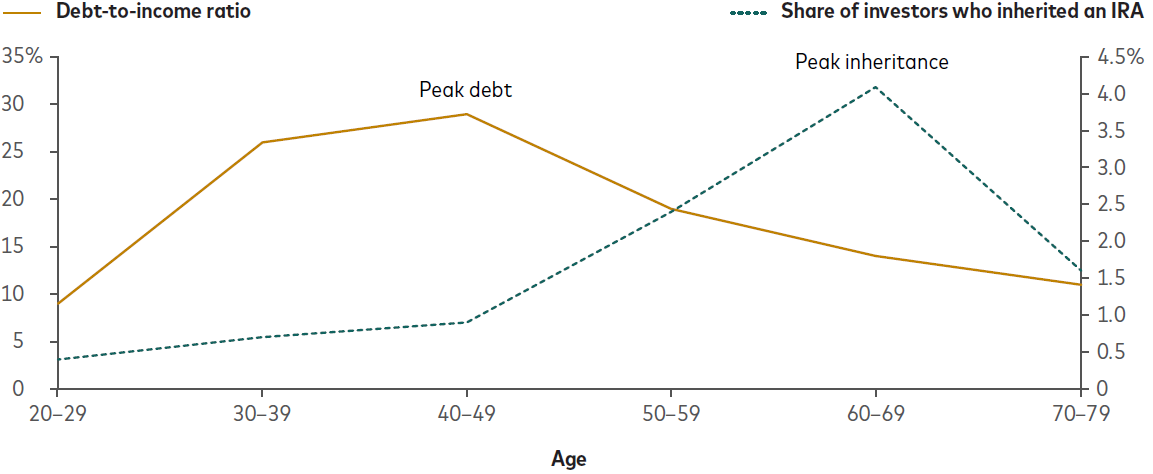
Notes: To calculate the debt-to-income ratio, we analyzed 250,000 Vanguard 401(k) participants for whom we have income and age data and linked credit bureau data for 2023. We added the total minimum required monthly payments for each person for any mortgages, student loans, auto loans, and revolving credit card debt, and divided the total monthly debt payment by monthly pre-tax income (annual income divided by 12). To calculate the share of inheritances, we analyzed 57,956 Vanguard clients who inherited an IRA in 2023 and for whom age at receipt is observed and reported the distribution of inheritance receipts by age decade. While inheritances here refer to IRAs, which can only be inherited when a grantor passes away, survey responses indicate this is consistent with the way most inheritances are passed on, with more than 90% of heirs receiving assets only after a grantor’s death.
Sources: Vanguard calculations, using Vanguard administrative data matched anonymously with Equifax data.
Inheritance typically increases beneficiaries’ investable assets by 30%. The gains are greater for younger heirs—for beneficiaries in their thirties, inherited IRAs increase investable assets by approximately 66%, compared with only 22% for those in their sixties and 16% for those in their seventies, according to Vanguard administrative data. Survey results show a similar pattern: Respondents in their thirties reported an increase in net worth from inheritance of 80%, compared with 21% among those in their seventies.
Benefits extend beyond account balances
Half of heirs reported that receiving an inheritance increased their financial peace of mind, according to the research. Those benefits were particularly pronounced among younger heirs, those with lower levels of assets, and those carrying debt.
And heirs who discussed inheritance plans with grantors in advance and those who sought professional guidance reported significantly greater peace of mind.
Despite these benefits, only 54% of heirs reported having a conversation about their inheritance before receiving it. Common reasons for avoiding such conversations were that finances were simply not discussed within the family and heirs assumed grantors were uncomfortable with the topic.
“Families are staying quiet to avoid a discomfort that might not exist,” Goncharova said. “And they’re missing out on real emotional benefits.”
Peace of mind gains are largest for younger heirs and those who seek advice
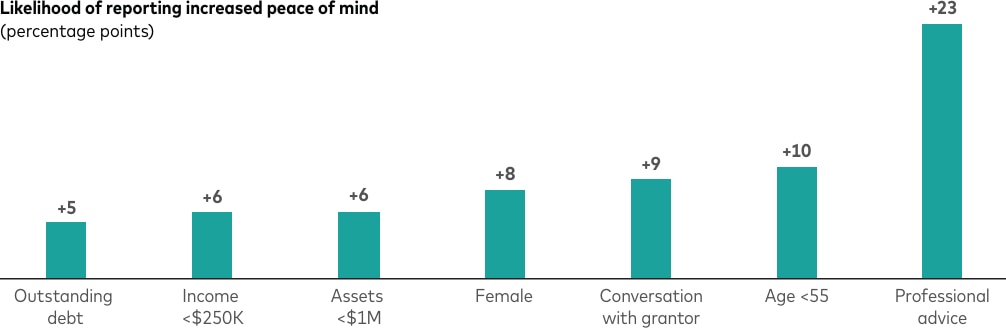
Notes: The survey question asked respondents, “Has receiving your inheritance changed your level of peace of mind regarding your finances? It has given me (a lot more/more/neither more nor less/less/a lot less) peace of mind.” A linear regression was used to estimate the effect of the following dummy variables on whether respondents felt “more” or “a lot more” peace of mind: Heir has outstanding debt, heir has annual income below $250,000, heir has less than $1 million in assets, heir is female, heir had a conversation with grantor, heir is younger than 55, and heir sought professional advice about inheritance. Continuous variables (age, assets, and income) were split at the median to create dummy variables.
Source: Vanguard.
Inheritance can remedy debt
Inheritance poses planning and decision-making challenges, such as how to invest assets, how to manage taxes, and how to decide whether inherited wealth should be used to pay down debt.
Many households appear to evaluate these decisions in isolation rather than looking at inherited assets and liabilities together as part of one overall financial picture. Among heirs who inherited an IRA, most (54%) had outstanding debt, and the average debt balance was larger than the inheritance itself ($141,000 versus $106,000), according to the research. Many heirs carry revolving credit card debt, which often incurs more than 20% in interest, that they could pay off entirely with their inheritance. Yet heirs are far more likely to reinvest their inheritance (68%) than use it to pay down debt (11%).
“We were surprised that heirs consider inherited assets and existing debt separately,” said Malena de la Fuente, Vanguard investment strategy analyst and coauthor of the paper. “Inheritance is a prime opportunity to tackle the debt side of the balance sheet and achieve guaranteed returns by avoiding costly interest.”
Three lessons from the research
As the Great Wealth Transfer unfolds, the paper’s findings point to three practical lessons:
- Inheritance often arrives after peak financial need. Grantors should consider lifetime giving to help strengthen their family’s financial foundation earlier.2
- Conversations before the transfer can matter as much as decisions afterward, but silence is still common between grantors and heirs. Families can achieve greater financial peace of mind and satisfaction by talking openly about inheritance in advance.
- Heirs should consider their whole balance sheet when deciding how to handle their inheritance. Thinking about debt, savings, taxes, and investment goals together may lead to better outcomes.
1 U.S. High-net-worth and Ultra-high-net-worth Markets 2024. The Great Wealth Transfer: Capturing Money in Motion. Cerulli Associates, 2024. https://www.cerulli.com/reports/us-high-net-worth-and-ultra-high-net-worth-markets-2024.
2 For very large estates, additional tax considerations such as the generation-skipping transfer tax may apply. These rules affect a small subset of high-net-worth households, and professional estate planning guidance is typically recommended.


Note
All investments are subject to risk, including the possible loss of the money you invest.
We recommend that you consult a tax or financial advisor about your individual situation.