Research summary
Choosing your private equity point of entry
September 10, 2026
Ultra-high-net-worth and institutional investors have long used private equity to pursue enhanced portfolio returns and diversification. As options have expanded across fund structures, a new question takes center stage: how to gain exposure.
A new Vanguard research paper, Investing in Private Equity: A Decision Framework for Drawdown Versus Semiliquid Funds, compares two of the most common private equity structures:
- Traditional drawdown funds call and distribute investor capital based on market opportunities, avoiding the potential performance drag that can result from holding liquid assets to meet periodic redemption requests. This makes drawdown funds particularly attractive to investors with very long time horizons and a high tolerance for liquidity risk.
- By contrast, semiliquid funds offer more flexible access, simplified administration, and periodic redemption opportunities, making them attractive to investors seeking easier implementation and greater liquidity.1
“Neither approach is inherently superior,” said Michael Rabinovich, one of the paper’s three authors. “Instead, the right choice depends on an investor's liquidity needs, expected holding period, all-in cost, the quality of the managers an investor can access, and the investor’s willingness to manage the operational complexity that comes with a drawdown program. Some investors settle on a structure without weighing every factor.”
The paper introduces a practical framework, summarized in the decision flow chart below, that helps investors assess key trade-offs and make a more informed choice between the two structures.
Decision flow chart for choosing the appropriate private equity fund structure
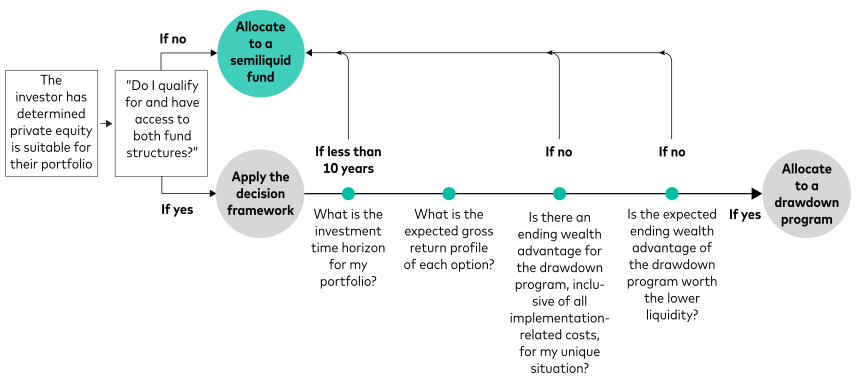
Notes: This chart does not purport to promise better returns; rather, it offers a clear decision-making process for use in fund structure selection. Because realized outcomes may be higher or lower than expected, investors should assess the results under a range of plausible assumptions. For additional information on suitability criteria and portfolio sizing, see Douglas M. Grim, Ankul Daga, Joana Rocha, and Ariana Abousaeedi, 2026. Right-Sizing Private Equity in a Portfolio: It Depends on More Than You Think. , and Roger Aliaga-Díaz, Giulio Renzi-Ricci, Brennan O’Connor, and Harshdeep Ahluwalia, 2022. Integrating Private Equity in a Liquid Multi-Asset Portfolio. The Journal of Portfolio Management 48(9): 39–60. © 2022 With Intelligence.
Source: Vanguard.
“Much of the existing research is qualitative, focused primarily on describing how these two fund structures differ,” said Ariana Abousaeedi, another of the paper’s authors. “We wanted to go further and allow investors to actually quantify what those differences could mean for their own outcomes.”
Ultimately, the research emphasizes that selecting a private equity vehicle is not simply about choosing the structure with the highest potential return. Instead, investors are most likely to achieve successful outcomes when the fund structure aligns with their individual circumstances, preferences, and liquidity needs.
Read the full Vanguard research paper for details on the framework and key considerations for private equity implementation.
1 Implementation of limits or suspension of redemption opportunities is possible in certain circumstances.



Notes:
Private investments involve a high degree of risk and, therefore, should be undertaken only by prospective investors capable of evaluating and bearing the risks such an investment represents. Investors in private equity generally must meet certain minimum financial qualifications that may make it unsuitable for specific market participants.
Private equity is generally only accessible to ultra-high-net-worth investors, either through direct investment or partnership with a private equity firm, which invests in a private equity fund. Only accredited investors who meet specific qualifications outlined in federal securities laws qualify to invest in private equity funds. Certain private equity funds require investors to meet the definition of "qualified purchaser" in addition to being an accredited investor.
All investing is subject to risk, including the possible loss of the money you invest. Be aware that fluctuations in the financial markets and other factors may cause declines in the value of your account. There is no guarantee that any particular asset allocation or mix of funds will meet your investment objectives or provide you with a given level of income. Diversification does not ensure a profit or protect against a loss.