Expert insight
Beyond beta: Charting the evolution of index investing
February 24, 2026
Indexing has grown from a single strategy choice to offering diverse strategies for more tailored portfolios.
Highlights
- Index fund investing has evolved from tracking a single benchmark—the S&P 500—to a wide array of strategies, reflecting a growing emphasis on investor choice.
- Because funds with similar labels can differ significantly in terms of composition, understanding the characteristics of the index a fund tracks is key.
- The future of index fund investing lies in even greater differentiation via innovations such as direct indexing, strategy-specific overlays, and tax-smart strategies that will continue to redefine what “index fund investing” means.
Fifty years ago, Vanguard launched the first index mutual fund, offering investors unprecedented access to the Standard & Poor’s 500 Index. Since then, index fund investing has expanded to include strategies targeting specific sectors, styles, market-capitalization segments, factors, and regions. The shift from a single-fund strategy to index-based building blocks reflects a growing emphasis on investor choice, low-cost implementation, and the integration of “passive” tools into actively oriented portfolios.
Index strategies: From monolith to mosaic
When index mutual fund investing started, there was only one game in town: the S&P 500 Index. For a long time after that, index fund investing was virtually synonymous with tracking “America’s index,” anchoring millions of portfolios to the benefits of broad diversification, cost efficiency, and precision.
But as markets have matured and investor preferences have shifted, indexing has grown to encompass thousands of benchmarks with distinct security compositions.
Index fund strategies today offer a mosaic of choices. The chart that follows illustrates that while the S&P 500 continues to represent a significant proportion of U.S. equity index fund assets, non-S&P 500 strategies have been capturing share. Beyond that, large-cap strategies now share the stage with indexes tracking various sizes, styles, and sectors. This expansion of index strategies enables more precise portfolio construction aligned with investor goals.
In index fund investing, no single strategy prevails
Notes: The chart depicts the total U.S. assets in U.S. dollars of U.S.-domiciled equity index mutual funds and ETFs, annually from December 31, 1976, to December 31, 2024. Funds are grouped into 12 mutually exclusive categories. The U.S. Total Market category comprises any fund whose primary prospectus benchmark is a total market index, such as the Russell 3000 Index or Wilshire 5000 Index, or any fund that otherwise indicates total market coverage in its fund legal name or prospectus. Funds not in the U.S. Total Market category are U.S. nontotal market funds and comprise the remaining 11 categories. The S&P 500 category comprises any U.S. nontotal market fund whose primary prospectus benchmark is the S&P 500 Index or any fund that otherwise indicates it tracks the S&P 500 Index in its fund legal name or prospectus. Any U.S. nontotal market fund that does not track the S&P 500 Index is categorized according to its Morningstar U.S. category group: Sector equity funds are categorized as U.S. Sector Equity and U.S. equity funds are categorized according to their Morningstar category as one of U.S. Fund Small Value, U.S. Fund Small Growth, U.S. Fund Small Blend, U.S. Fund Mid-Cap Value, U.S. Fund Mid-Cap Growth, U.S. Fund Mid-Cap Blend, U.S. Fund Large Value, U.S. Fund Large Growth, or U.S. Fund Large Blend.
Sources: Vanguard calculations, using data from Morningstar, Inc., and FactSet, as of December 31, 2024.
Index labels: What’s in a name?
U.S. “Total market” indexes tend to be similar. However, when index providers carve up the total market, they can use very different methodologies, resulting in differentiated exposures for similarly labeled categories.
Even within index fund categories, each provider has its own distinct approach to benchmark construction. Methodological decisions determined by each benchmark provider—such as size segmentation, growth or value classification, and rebalancing cadences—can significantly affect portfolio composition.
Consider these distinctions:
- Size segmentation: There is no single standard among index providers. Some providers segment size based on number of constituents, while others do so on cumulative market capitalization.
- Growth/value classification: This also varies by index provider. Not only do providers consider different variables to determine growth or value—which can include earnings growth, price-to-book ratio, and dividend yield—but they also use those variables differently to decide which stocks and how much of their market capitalization get designated as growth or value.
- Rebalancing cadence: While some indexes rebalance quarterly, others rebalance semiannually. The rebalancing methods seek to balance maintaining an index that reflects the relevant market exposure with taking into account real-world transaction costs.
These differences matter. For instance, the count-based methodologies of S&P and Russell yield both a different number of stocks and a different proportion of market capitalization in their indexes. CRSP’s market-cap-based methodology tends to result in a larger-cap bias, as illustrated by its weighted-average market capitalization of around $38 billion in its mid-cap index and $9 billion in its small-cap index, each greater than those in the offerings from Russell and S&P.
Choosing an index fund is not just about picking a label—the process begins by understanding the characteristics of the index it tracks.
How indexes stack up by number of holdings and market cap
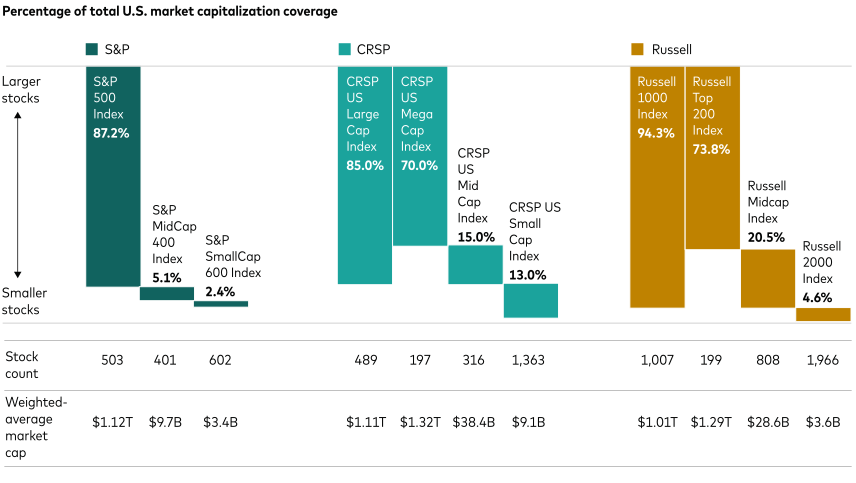
Notes: All index characteristics data are as of December 31, 2024. CRSP percentages represent methodology targets.
Sources: Vanguard, using data from S&P Dow Jones, FTSE Russell, and CRSP.
The next chapter: Greater differentiation
In practice, investors routinely combine index funds—across sectors, styles, factors, and regions—to achieve targeted outcomes aligned with their unique risk profiles and convictions at the aggregated portfolio level. These strategies have become building blocks for active portfolio construction.
The future of index fund investing lies in even greater differentiation. Direct indexing, strategy-specific overlays, and tax-smart strategies are just a few of the innovations that will continue to redefine what “index fund investing” means. Investors will increasingly pursue their goals by constructing balanced, low-cost portfolios built on index funds—without losing the diversification and affordability that made index fund investing revolutionary in the first place.


Notes:
All investing is subject to risk, including the possible loss of the money you invest.
Diversification does not ensure a profit or protect against a loss.
Past performance is no guarantee of future returns. The performance of an index is not an exact representation of any particular investment, as you cannot invest directly in an index.
CFA® and Chartered Financial Analyst® are registered trademarks owned by CFA Institute.
Contributors


Ollie Ryder-Green