Investment research and strategy
Our in-house think tank
Vanguard’s Investment Strategy Group (ISG) is an internal research team of economists, investment strategists, behavioral researchers, household finance experts, and quantitative analysts. This lead in-house think tank produces relevant and rigorous insights on economics, markets, portfolio strategies, retirement matters and investor behavior. The group also develops and oversees Vanguard’s proprietary modeling and forecasting tools.
A global, interdisciplinary approach
A global, interdisciplinary approach
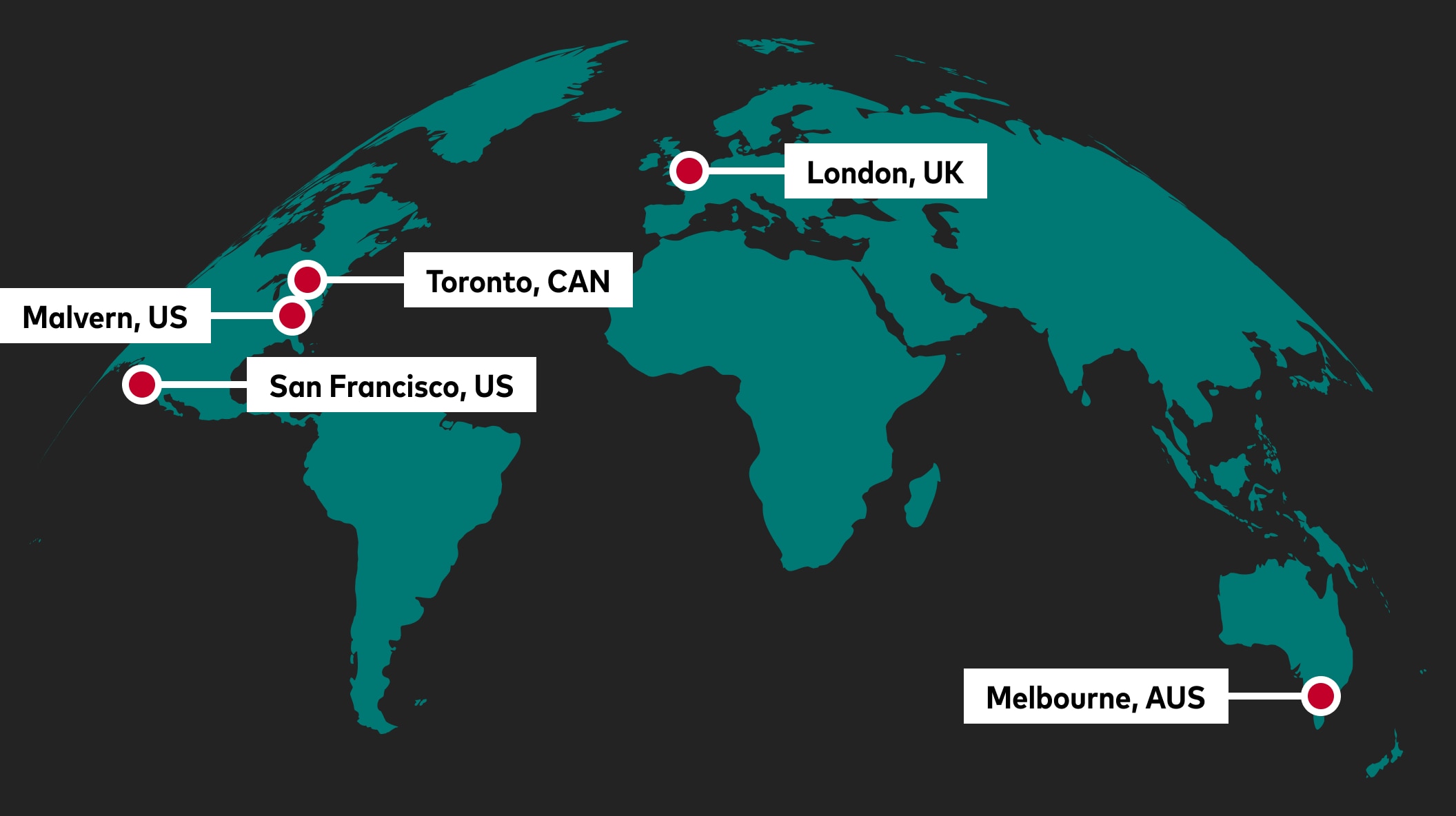
Vanguard provides research-based insights and analysis to support its investment management teams, business leaders, and external audiences, informed by work conducted across the organization.
As part of Vanguard’s Investment Management Group, the Investment Strategy Group provides analysis and guidance to Vanguard portfolio managers, particularly in the Fixed Income Group, on topics such as the macroeconomic outlook, monetary policy, and market conditions that support fund management decisions. This approach has supported Vanguard active funds in their efforts to deliver competitive, sustained performance over time relative to peer groups.
Vanguard’s forecasting and modeling platforms support its investment and advice methodologies by providing constant inputs for portfolio construction recommendations. This work informs asset allocation across single-fund solutions (including target-date and life-cycle funds), ETF model portfolios, and Vanguard’s advice offerings globally.
Vanguard researchers collaborate with academics at institutions including Carnegie Mellon University, Columbia University, Georgetown University, the University of Michigan, New York University, Stanford University, the Wharton School of the University of Pennsylvania, and Yale University—as well as industry associations, including the Investment Company Institute and the European Fund and Asset Management Association. This research includes work on retirement-plan design trends, investor behavior, and surveys of investor views and beliefs.
Vanguard shares empirical research-based perspectives with policymakers, academics, retirement-plan sponsors, financial intermediaries, and other investment professionals to inform industry dialogue and practice.
Vanguard conducts primary research on global markets, economies, asset classes, and investor behavior. This work draws on proprietary forecasting models and deep expertise to produce empirical, academic-caliber analysis that supports investor decision-making and is presented through a practitioner’s lens.
Notes:
Vanguard ETF Shares are not redeemable with the issuing Fund other than in very large aggregations worth millions of dollars. Instead, investors must buy and sell Vanguard ETF Shares in the secondary market and hold those shares in a brokerage account. In doing so, the investor may incur brokerage commissions and may pay more than net asset value when buying and receive less than net asset value when selling.
All investing is subject to risk, including the possible loss of the money you invest. Be aware that fluctuations in the financial markets and other factors may cause declines in the value of your account. There is no guarantee that any particular asset allocation or mix of funds will meet your investment objectives or provide you with a given level of income.
The Factor Funds are subject to investment style risk, which is the chance that returns from the types of stocks in which a Factor Fund invests will trail returns from U.S. stock markets. The Factor Funds are also subject to manager risk, which is the chance that poor security selection will cause a Factor Fund to underperform its relevant benchmark or other funds with a similar investment objective, and sector risk, which is the chance that significant problems will affect a particular sector in which a Factor Fund invests, or that returns from that sector will trail returns from the overall stock market.
ESG funds are subject to ESG investment risk, which is the chance that the stocks or bonds screened by the index provider or advisor, as applicable, for ESG criteria generally will underperform the market as a whole or, in the aggregate, will trail returns of other funds screened for ESG criteria. The index provider or advisor’s assessment of a company, based on the company’s level of involvement in a particular industry or their own ESG criteria, may differ from that of other funds or an investor’s assessment of such company. As a result, the companies deemed eligible by the index provider or advisor may not reflect the beliefs and values of any particular investor and may not exhibit positive or favorable ESG characteristics. The evaluation of companies for ESG screening or integration is dependent on the timely and accurate reporting of ESG data by the companies. Successful application of the screens will depend on the index provider or advisor's proper identification and analysis of ESG data. The advisor may not be successful in assessing and identifying companies that have or will have a positive impact or support a given position. In some circumstances, companies could ultimately have a negative or no impact or support of a given position.
Investments in Target Retirement Funds are subject to the risks of their underlying funds. The year in the Fund name refers to the approximate year (the target date) when an investor in the Fund would retire and leave the work force. The Fund will gradually shift its emphasis from more aggressive investments to more conservative ones based on its target date. The Income Fund has a fixed investment allocation and is designed for investors who are already retired. An investment in a Target Retirement Fund is not guaranteed at any time, including on or after the target date.
Vanguard does not, and will not, make any representations about whether a model portfolio is in the best interest of any investor, is not, and will not be, responsible for the determination of whether a model portfolio is in the best interests of any investor, and is not acting as an investment advisor to any investor. It is the investment advisor’s responsibility to determine the appropriateness of the model portfolios, or any of the securities included therein, for any client.
IMPORTANT: The projections and other information generated by the Vanguard Capital Markets Model (VCMM) regarding the likelihood of various investment outcomes are hypothetical in nature, do not reflect actual investment results, and are not guarantees of future results. VCMM results will vary with each use and over time.
The VCMM projections are based on a statistical analysis of historical data. Future returns may behave differently from the historical patterns captured in the VCMM. More importantly, the VCMM may be underestimating extreme negative scenarios unobserved in the historical period on which the model estimation is based.
The Vanguard Capital Markets Model® is a proprietary financial simulation tool developed and maintained by Vanguard's primary investment research and advice teams. The model forecasts distributions of future returns for a wide array of broad asset classes. Those asset classes include U.S. and international equity markets, several maturities of the U.S. Treasury and corporate fixed income markets, international fixed income markets, U.S. money markets, U.S. municipal bonds, commodities, and certain alternative investment strategies. The theoretical and empirical foundation for the Vanguard Capital Markets Model is that the returns of various asset classes reflect the compensation investors require for bearing different types of systematic risk (beta). At the core of the model are estimates of the dynamic statistical relationship between risk factors and asset returns, obtained from statistical analysis based on available monthly financial and economic data from as early as 1960. Using a system of estimated equations, the model then applies a Monte Carlo simulation method to project the estimated interrelationships among risk factors and asset classes as well as uncertainty and randomness over time. The model generates a large set of simulated outcomes for each asset class over time. Forecasts represent the distribution of geometric returns over different time horizons. Results produced by the tool will vary with each use and over time.
Vanguard's advice services are provided by Vanguard Advisers, Inc. ("VAI"), a registered investment advisor.
The services provided to clients will vary based upon the service selected, including management, fees, eligibility, and access to an advisor. Find VAI's Form CRS and each program's advisory brochure here for an overview of the program.
VAI is a subsidiary of The Vanguard Group, Inc., and an affiliate of Vanguard Marketing Corporation. Neither VAI nor its affiliates guarantee profits or protection from losses.