Expert insight
The right tools can help bond index funds stay on track
March 04, 2026
Index fund investors can benefit when funds closely track benchmarks.
Highlights
- Fully replicating a bond benchmark can be challenging because of the breadth of the bond market and the limited liquidity in certain market segments.
- Successful bond index fund management hinges on aligning a portfolio’s key risk factor exposures with those of its benchmark to minimize tracking error and transaction costs.
- Deep investment expertise and a collaborative process help bond index fund managers achieve tight benchmark tracking.
An index fund is designed to capture the risk and return of an appropriate benchmark. While achieving that sounds easy, it requires a sophisticated approach. The challenges are amplified for bond index fund managers because of the breadth and liquidity features of bond markets. This research explores how bond index fund managers, amid uncertain and dynamic markets, navigate complexity and volatility to keep portfolios closely aligned with their benchmarks while remaining agile enough to seize opportunities.
Bond index fund managers face unique challenges
Equity index fund managers typically achieve tight benchmark tracking by owning all index securities in their proportional weights. For bond index fund managers, this is generally impractical because the bond market is so large—the Bloomberg U.S. Aggregate Bond Index contained nearly 14,000 securities as of September 2025—and many bonds trade with limited liquidity.
Sampling is one tool for managing this complexity. By selecting a representative set of bonds, fund managers aim to align the portfolio’s principal risk factors with the index’s. While risk factors such as duration, credit quality, sector, and issuer exposure are some of the most important to match, dozens are often incorporated into the investment process.
However, sampling alone isn’t enough. Managers use advanced techniques that integrate multifactor risk analysis and optimization methods (for example, quantitative tools that find the best combination of bonds) to construct portfolios that balance expected risks, returns, and costs to minimize tracking error.
Risk alignment and cost management can help improve investor results
To demonstrate this balancing act, we simulated the performance of two hypothetical portfolios and compared the tracking error of each against the Bloomberg U.S. Aggregate Bond Index.
The first (the “risk-aligned” portfolio) randomly sampled bonds from the benchmark and aligned the portfolio’s duration, credit quality, and sector exposures with the benchmark’s. This analysis focused on these risk exposures given their sizable impact on bond returns.1 The other (the “non-risk-aligned” portfolio) also randomly sampled bonds from the benchmark but didn’t match its risk factor exposures.2
The figure below highlights two items:
1. Tracking error declines as portfolio size increases, with the risk-aligned portfolio consistently showing lower tracking error than the non-risk-aligned portfolio.
2. Estimated transaction costs increase with portfolio size. This underscores the need to balance both, which experienced managers carefully navigate, particularly during volatile markets when liquidity and trading costs can shift quickly.
Risk factor alignment strikes a balance between tracking error and transaction costs
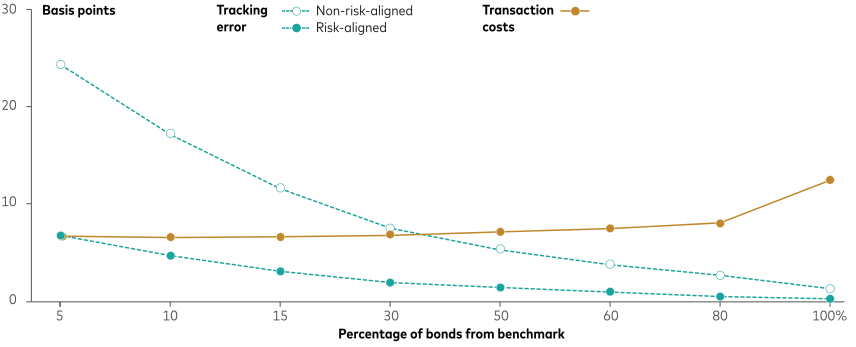
Notes: Each tracking error data point represents the estimated median monthly tracking error across 500 simulations of each portfolio that contains a given percentage of bonds from the benchmark, the Bloomberg U.S. Aggregate Bond Index. The rescaled weights for each portfolio sum to 1. The percentages of bonds included in each portfolio are rounded to the nearest 5-percentage-point increment and are based on the average number of monthly benchmark constituents. Tracking error is calculated as the standard deviation of the monthly excess returns between the portfolio and the benchmark. Each transaction cost data point represents the monthly round-trip cost, quoted in price, to trade an entire portfolio (that is, 100% turnover) that contains a given percentage of the bonds in the benchmark. We estimate portfolio-level transaction costs based on group-level transaction costs across key market sectors (such as Treasuries, mortgages, and corporates) and input from Vanguard’s Global Bond Index team. Trades are assumed to be done pro rata across each sector in the benchmark based on average monthly sector weights.
Sources: Vanguard calculations, using data from RIMES, Bloomberg, and MarketAxess® from October 2020 through September 2025.
Past performance is no guarantee of future returns. The performance of an index is not an exact representation of any particular investment, as you cannot invest directly in an index.
Aligning a portfolio’s risk factor exposures with the benchmark’s is paramount for precise bond benchmark tracking. It helps minimize risk-based tracking error and reduce transaction costs because fund managers can avoid trading the most expensive bonds.
Collaboration is key to navigating complex events
In June 2025, a credit event involving Warner Bros. Discovery (WBD) showcased how Vanguard’s Global Bond Index (GBI) team adds value through risk alignment, cost management, and opportunistic positioning. A few months earlier, our Credit Research team flagged signs of WBD’s credit-quality deterioration and the potential downgrade to high yield, or below investment grade, which could cause WBD’s bonds to be removed from the Bloomberg U.S. Aggregate Bond Index. Subsequently, GBI partnered with Credit Research to analyze tender offer details, index implications, and capital structure changes to inform risk management and portfolio positioning.
Using Credit Research’s insights, the GBI team initially aligned portfolios with the Bloomberg U.S. Aggregate Bond Index’s risk exposure for WBD bonds while favoring those bonds most likely to be tendered. When WBD restructured its debt later in June and did a tender/exchange, the GBI team capitalized on favorable pricing by exchanging its existing WBD bonds for new issues. The new bonds then outperformed—by nearly 12 percentage points in some cases—legacy WBD bonds that remained in the benchmark for the rest of the month.
These actions helped the GBI team preserve investor capital, avoid holding legacy bonds that could create future tracking error, add incremental return, and sidestep transaction costs.
Investors benefit when index funds closely track benchmarks
Achieving tight benchmark tracking ensures that bond index funds deliver the market return investors expect. This is critical during periods of market volatility, especially because bonds typically act as a stabilizer against equity market sell-offs. For investors, choosing a bond index fund that tracks its benchmark closely helps enable the fund to fulfill its role in a portfolio when that matters most.
Despite the challenges posed by market volatility, bond index fund managers remain focused on delivering precise benchmark tracking. Volatility can affect transaction costs and liquidity yet also creates short-lived opportunities. Bond index fund managers achieve their objective by focusing on key risk drivers, controlling costs, and acting decisively when opportunities arise, turning complexity into a disciplined pursuit of value.
1 The risk-aligned portfolio matched the benchmark’s duration, credit-quality, and sector risk factor exposures by sampling bonds from the benchmark and rescaling their weights accordingly. For further details, see Fabozzi, Frank J., Steven V. Mann, and Francesco Fabozzi, 2021. The Handbook of Fixed Income Securities, Ninth Edition. McGraw Hill.
2 For more detail on portfolio optimizations, see Markowitz, Harry, 1952. Portfolio Selection. The Journal of Finance. https://www.jstor.org/stable/2975974.


Notes:
All investing is subject to risk, including the possible loss of the money you invest. Past performance is not a guarantee of future results.
Investments in bonds are subject to interest rate, credit, and inflation risk. Bond funds are subject to the risk that an issuer will fail to make payments on time, and that bond prices will decline because of rising interest rates or negative perceptions of an issuer's ability to make payments.
CFA® is a registered trademark owned by CFA Institute.
Certified Financial Planner Board of Standards Inc. owns the certification marks CFP® and Certified Financial Planner™ in the U.S., which it awards to individuals who successfully complete CFP Board’s initial and ongoing certification requirements.
© 2025 MarketAxess Holdings Inc. Underlying data © 2025 FINRA. All data is provided as is, with no warranties.
Contributors