Investment perspectives
IPOs drew crowds, not a frenzy
November 23, 2026
Three of 2026's most anticipated stock offerings dominated headlines. But new Vanguard client insights research, built on the actual trading activity of its investor accounts, tells a different story about what really happened. The data offers a rare, firsthand look at how real investors respond when the market tells them to pay attention.
A string of headline stock debuts marked 2026: SpaceX in June ($75B), SK Hynix's U.S. listing in July ($26.5B), and Anthropic in November ($81.3B). Each generated considerable media attention. Yet the data tells a quieter story: most Vanguard investors let their diversified funds and long-term plans do the work, rather than chasing the buzz of opening day.
A near-record crowd, but no broad rush
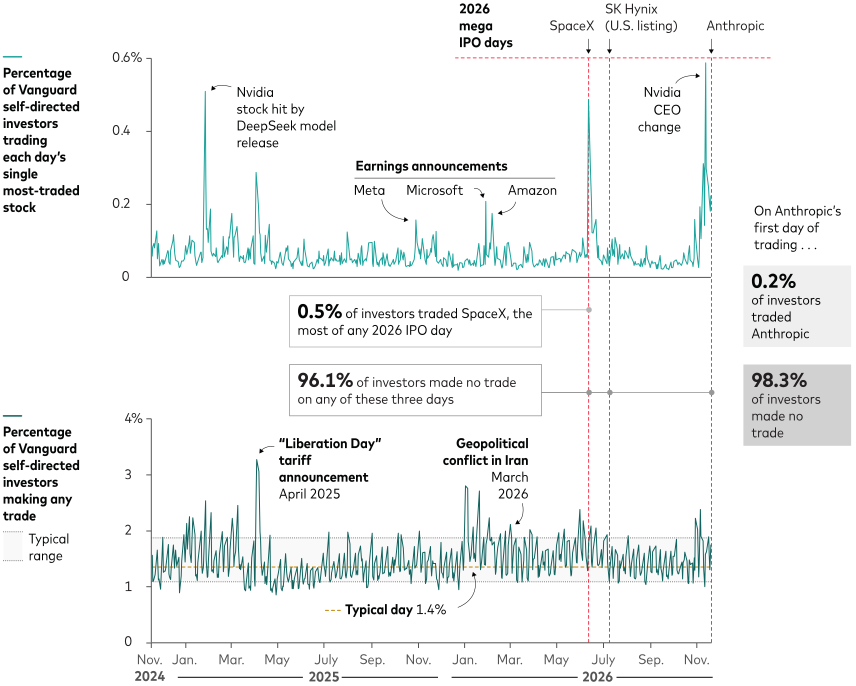
As single-name events, the mega IPOs were large but not unprecedented. SpaceX’s debut ranks third among the busiest single-stock days of the past two years, behind two NVIDIA days: the DeepSeek news in January 2025 and the company’s CEO change on November 12, 2026. Anthropic drew fewer investors than SpaceX but was still the most-traded stock on Vanguard’s platform on its first day. Here's the twist: even the biggest launches did not ignite broader activity. Overall self-directed trading on Anthropic and SpaceX’s first day stayed close to typical-day norms, 1.7%, and 1.8% respectively, and about half of those who traded anything traded only funds and ETFs. “A single name can top the day's most-traded list without changing most investors' plans,” said Xiao Xu, Vanguard senior investment strategist.
Figure 1. Trading activities of Vanguard self-directed investors leading up to mega stock offerings
Source:
Vanguard calculation based on administrative data on retail investor trading. The top panel shows the single most-traded stock each day using the percentage of self-directed investor trading the stock; labels mark some stocks’ busiest days and the related news events. The bottom panel shows the share of self-directed investors making any trade each day with markers for market-wide events (April 2025 tariffs, February 2026 geopolitical conflict). The rightmost datapoints on both panels mark November 19, 2026.
Zooming in on Vanguard investor buying activity
Across the three largest stock offerings of 2026, only a sliver of Vanguard investors purchased the newly listed stocks, and 96.1% made no trade at all on any of the three listing days. Even for the two mega IPOs, both household names, just 0.2% of Vanguard's self-directed investors bought Anthropic and only 0.5% bought SpaceX on their first IPO day, against a typical-day baseline of roughly 0.05% for the most traded stock. SK Hynix, a Korean semiconductor company listing its shares in the U.S., drew fewer than 3 in 10,000. About 7 in 10 buyers across the offerings were men, and buyers of every offering skewed older and wealthier than Vanguard's typical investor, SK Hynix buyers by a wide margin.
Few investors bought the IPOs to sell them immediately. Only 1.9% of Anthropic buyers sold it the same day, compared with 2.8 % of SpaceX and SK Hynix buyers.
Most investors didn’t appear to sell other holdings to buy mega IPOs: Among Anthropic and Space X buyers, nearly nine in 10 sold no other stocks or ETFs that day, and about three-quarters sold none in the week before. They likely used cash already in the account, their money market settlement fund, or new money.
Most IPO buyers kept their individual stock allocations small
At the median, buyers invested 1.1% of their portfolio balance in Anthropic, 1.7% in SpaceX and 1.1% in SK Hynix. For Anthropic, the median buyer purchased about 20 shares for around $2,000, 13 shares at around $2,150 for SpaceX, and 20 shares at around $3,400 for SK Hynix.
Few investors bought into multiple mega IPOs. Of investors who bought any of the three, 93% bought just one.
“What stands out isn't the IPOs, it's how little they changed for most investors,” said Fiona Greig, global head of investor research and policy.
The real risk sits in the tail, not the median: roughly 2.2% of Anthropic buyers put more than half of their portfolio into the stock, as did 2.9% of SpaceX buyers, compared with 2% for SK Hynix. These concentrated bets were mostly placed by investors with no broad index fund at Vanguard holding smaller accounts, where a single trade can swamp a low balance.
“Most buyers treated these IPOs as fun money, the seasoning on the steak. A few made them the main course,” said Andy Reed, Vanguard head of behavioral economics research.
What IPO investing it means for long-term goals
Vanguard founder Jack Bogle famously told people, “Don't look for the needle in the haystack. Just buy the haystack.” Still, he recognized many investors want to act on a conviction, and suggested keeping such bets in a small “funny money” allocation so the core stays intact. Investors in broadly diversified funds will likely come to own companies like SpaceX and Anthropic indirectly over time, so owning individual stocks directly is not typically necessary to achieve one's financial goals.1 FOMO can push investors toward the moment of greatest hype, but a high-profile IPO should not change an investor's goals or rewrite their financial plan.
For individual investors: Keep IPO risk in perspective
- The value of a newly listed company can swing widely, and these stocks are not guaranteed to outperform in the long run. Before investing in individual names like these, it is prudent to carefully consider the risk involved.
- Broad, low-cost index funds, including many target-date funds, let investors participate in the market’s growth—and most big IPOs, eventually—without having to pick winners. 1
- Before investing in single stocks, people should consider whether their financial goals have changed and whether their investment allocations support those goals. Explore Vanguard’s principles for investing success.
For financial professionals: Use IPO interest as a coaching opportunity
- Interest in a single name peaks around its launch, and so does the temptation to concentrate. Start with the “why”—understanding what draws a client to a stock—builds trust and opens the door to helping them participate, if they choose to, in a way that fits their plan and risk tolerance. Explore Vanguard's behavioral coaching resources.
- History teaches us to be humble about knowing who the eventual winners will be. Over time, some of the biggest beneficiaries of AI may be companies that use the technology, not just those building it today. So, stay invested but broaden out.
The headline-grabbing debuts of 2026 made for a loud year in the market, but a quiet one in most portfolios. Vanguard investors largely treated SpaceX, SK Hynix, and Anthropic as spectacle rather than strategy: a small satellite allocation, not a rewrite of the plan. When a single stock dominates the headlines, the data suggests most investors simply let the moment pass, trusting the plan they have already built over the hype of the headlines.
1 For instance, Vanguard Total Stock Market ETF (VTI) included SpaceX at the close of the fifth trading day post-IPO, and Vanguard 500 Index ETF (VOO) will include SpaceX after approximately 12 months, pending decisions by S&P 500 Index provider. S&P 500 Index adopted slow inclusion. There is an approximately 12-month wait time (subject to profitability screen). See Vanguard's “Staying grounded amid moonshot IPOs.”


Notes:
For more information about Vanguard funds and Vanguard ETFs, visit vanguard.com to obtain a prospectus or, if available, a summary prospectus. Investment objectives, risks, charges, expenses, and other important information are contained in the prospectus; read and consider it carefully before investing.
Vanguard ETF Shares are not redeemable with the issuing Fund other than in very large aggregations worth millions of dollars. Instead, investors must buy and sell Vanguard ETF Shares in the secondary market and hold those shares in a brokerage account. In doing so, the investor may incur brokerage commissions and may pay more than net asset value when buying and receive less than net asset value when selling.
All investing is subject to risk, including possible loss of principal. Be aware that fluctuations in the financial markets and other factors may cause declines in the value of your account. There is no guarantee that any particular asset allocation or mix of funds will meet your investment objectives or provide you with a given level of income.
Diversification does not ensure a profit or protect against a loss.
Investments in Target Retirement Funds are subject to the risks of their underlying funds. The year in the Fund name refers to the approximate year (the target date) when an investor in the Fund would retire and leave the workforce. The Fund will gradually shift its emphasis from more aggressive investments to more conservative ones based on its target date. The Income Fund has a fixed investment allocation and is designed for investors who are already retired. An investment in a Target Retirement Fund is not guaranteed at any time, including on or after the target date.
Contributors