Economics & markets
Beyond CCCs, high-yield appears resilient
November 10, 2026
Is the high-yield bond market sending a warning? Spreads on CCC-rated bonds have widened by more than 500 basis points from their lowest levels this year, to roughly 1,000 basis points over Treasuries. Meanwhile, spreads on higher-quality BB- and B-rated bonds have remained relatively contained.
Because of their lower credit quality, CCC-rated bonds typically trade at a discount to the rest of high-yield. That discount is now larger than at any point since the COVID-19 market sell-off, raising investor concern about broader credit deterioration. The important question is whether the cracks at the bottom of the high-yield market are a signal for the broader credit market.
A closer look at the Bloomberg U.S. Corporate High Yield Index suggests the picture is more nuanced: stress is concentrated, the market is higher quality than in the past, and attractive income opportunities remain.
The sell-off is sharp, but narrow
Four out of more than 150 CCC-rated issuers make up more than 30% of current CCC-rated bond spreads. Many of the companies most affected are in the telecommunications and media sector, where secular headwinds and company-specific challenges are driving distress.
In other words, this has not been an indiscriminate repricing of credit risk. But that doesn’t mean investors should ignore it. Financial conditions have tightened this year. Interest rates on the broad U.S. bond market have increased by nearly 100 basis points, and this tightening is filtering through to parts of the credit market. Distress often appears first in the lowest-quality companies, which is not uncommon in the later stages of the credit cycle.
Distress in CCCs has been acute, but largely contained, highlighting a sharp divide between the weakest borrowers and the rest of the credit market. In much of the investment-grade and higher-quality high-yield corporate bond universe, fundamentals remain healthy. Corporations have seen record-high earnings. Through November 6, 88% of companies in the Standard & Poor’s 500 Index (S&P 500) had reported third-quarter earnings, with earnings-per-share growth of 29%. Many also have strong and stable balance sheets, conservative management—with low and stable leverage of roughly two times net debt-to-earnings before interest, taxes, depreciation, and amortization, or EBITDA, for S&P 500 companies, the lowest level since 2014—and positive rating trends. Resilient economic growth provides a supportive backdrop.
“In high-yield, you don’t get paid simply for taking more risk,” says Michael Chang, portfolio manager and head of Vanguard’s high-yield corporates team. “You get paid for taking the right risk. In a market where dispersion is increasing, disciplined credit selection becomes increasingly important, both in capturing opportunities and avoiding areas of fundamental weakness.”
High-yield risk has evolved
Today’s high-yield market is markedly different from prior decades. CCCs now make up less than 10% of the market, a more than 50% decrease in their share of the market heading into the Global Financial Crisis.
The improvement in traditional high-yield credit quality reflects a structural shift in credit markets. Over the past decade, a meaningful portion of lower-quality lending has migrated from traditional high-yield into private credit and leveraged loans.
The shift of risk between markets may be masking more volatility to come, particularly in the markets to which CCC-rated risk has moved. Traditional high-yield is often the first market to flash red in its daily trading activity, whereas less liquid markets may take longer to reflect deteriorating conditions. Signs of greater distress are emerging, as seen in rising defaults in private credit and elevated defaults in leveraged loans last year.
Signs of distress emerging in some credit markets
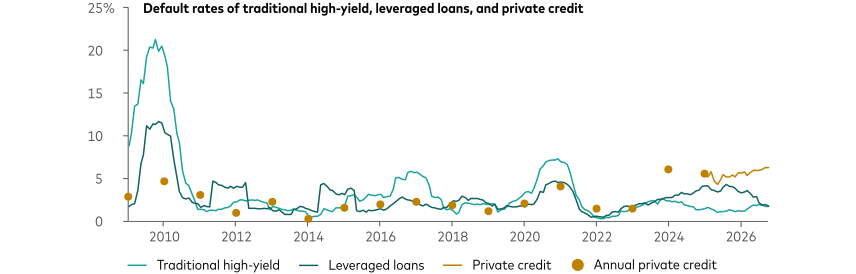
Notes: Data on private credit are annual through 2025 and monthly from January 2026 through September 2026.
Sources: Vanguard calculations based on Bloomberg and Fitch Ratings data as of September 30, 2026.
The opportunity for income
The sell-off in high-yield bonds is idiosyncratic and confined. At the same time, the high-yield bond market offers a higher-quality investment than in the past. The market yielded 8.21% as of November 6, providing a meaningful income cushion even as pockets of distress emerge.
Relative to the complex structures to which investors reached for yield during the low-rate period that preceded 2022, high-yield offers competitive income, transparency, and liquidity.
Navigating the credit cycle
The widening in CCC-rated credit spreads is a reminder that tighter financial conditions are raising the bar for issuers in the weakest corners of the credit market. For now, stress is concentrated, not broad-based. With high-yield credit quality higher today than in past late-cycle periods, and with some credit risk having shifted into leveraged loans and private credit, looking across credit markets and being more discerning will be key to navigating the next stage of the cycle.


Notes:
All investing is subject to risk, including possible loss of principal. Past performance is no guarantee of future results.
Bond funds are subject to the risk that an issuer will fail to make payments on time, and that bond prices will decline because of rising interest rates or negative perceptions of an issuer's ability to make payments.
High-yield bonds generally have medium- and lower-range credit quality ratings and are therefore subject to a higher level of credit risk than bonds with higher credit quality ratings.
Contributors

Michael Chang